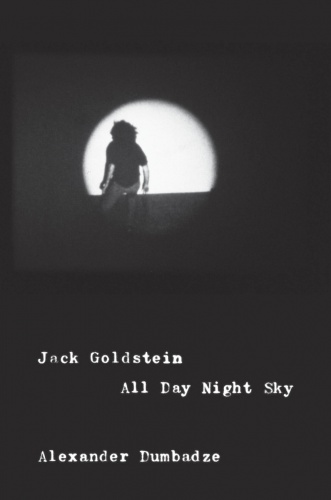
Jack Goldstein: All Day Night Sky
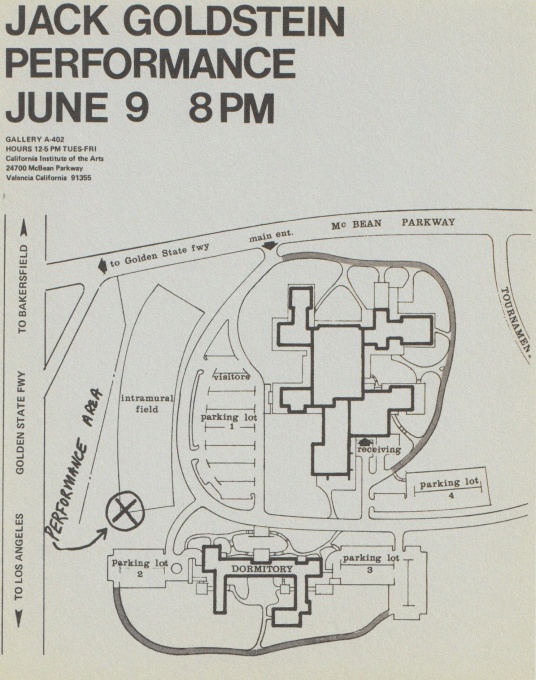
Exhibition flyer for Jack Goldstein’s performance Bural Piece (1972) at the California Institute of Arts, Valencia, CA.
On the evening of June 9, 1972, Jack Goldstein was buried on the campus grounds of CalArts, a class project for John Baldessari. He was placed in a wooden box and lowered into a four-foot-deep hole on the edge of the campus overlooking the 5 Freeway. Dirt from the excavated hole was shoveled over the box. There was of course a breathing tube keeping Goldstein alive, and also a sensor connecting his heartbeat to a flashing red light. He stayed underground for about an hour, a shorter stay than he had intended. Some of his peers who were in attendance thought he had underestimated the resolve needed to fulfill his ambitions for the piece.
Several months later he reprised the piece, this time laying in the makeshift coffin at the back of the Riko Mizuno Gallery, suspended between two chairs. This was a week after Chris Burden had lain under a tarp outside the same gallery, on La Cienega Boulevard, and a year after Burden had spent five days inside a three-by-three footlocker as part of his MFA thesis at UC Irvine.
During this time Goldstein was known for both the rigor of his thinking, and the intense attention he was paying to the work of those he considered rivals and peers. He pushed limits, but often in ways that were seen to be in relation to an already existing work, as if he were working his way through to his own voice. One of his CalArts peers, James Welling, has recalled that at the time, “Jack’s work always looked like someone else’s.”
Alexander Dumbadze’s recent book, Jack Goldstein: All Day Night Sky, published by University of Chicago Press, provides insight into these formative struggles, the emergence of the generationally significant work of the later ‘70s and early ‘80s, spanning sound, film, and painting, and the later psychic and creative collapse that brought his life to a tragic end. The book mixes biography, art theory, and archival research, and presents its argument through a non-linear structure that focuses our attention on themes concerning the inscrutability of images and their relation to lived experience.
The excerpted chapter here talks at length about Goldstein’s time as a graduate student at CalArts, working through several processes and projects as he grappled with a moment in art history that was all about seeking the limits of art making and the institutions that define the presentation of art.