Alex Olson and Andy Campbell on Takako Yamaguchi
by Anna Katz
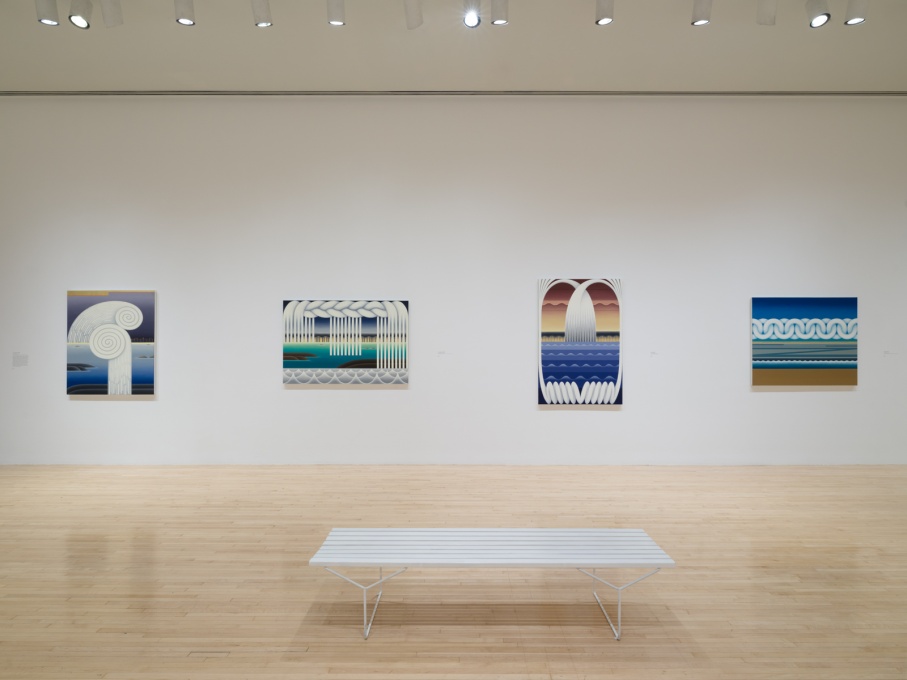
Installation view of MOCA Focus: Takako Yamaguchi, June 29, 2025–January 4, 2026 at MOCA Grand Avenue. Courtesy of The Museum of Contemporary Art (MOCA). Photo by Jeff McLane.
Introduction by Anna Katz
For more than forty years, Takako Yamaguchi (b. 1952, Okayama, Japan; lives in Santa Monica, California) has prized decoration, beauty, and fashion—values often excluded from serious consideration in contemporary art history and criticism. Coming of age as a painter in the 1970s, when the mainstream art world rewarded postures such as the tough, the angry, and the austere, Yamaguchi took the opposite tack. Following her studies at Bates College in Lewiston, Maine (BA 1975), and the University of California, Santa Barbara (MFA 1978), and her subsequent move to Los Angeles, in the early 1980s she created her first mature work under the influence of the Pattern and Decoration (P&D) movement and its critical, feminist embrace of ornament and excess. In the ensuing decades, driven by a contrarian impulse, Yamaguchi undertook to cull painterly forms from what she terms, paraphrasing poet Wallace Stevens, “the trash heap”1of discarded ideals of Modernism, from P&D to Mexican muralism, the nude, Art Nouveau, and Photorealism. Her most recent body of work, archly stylized seascapes produced between 2021 and 2025, is no exception, for what genre could be more lost and abandoned than the seascape?
From the start, Yamaguchi exhibited regularly, including eleven solo shows at Jan Baum Gallery between 1981 and 2006 and a solo museum show at the Nevada Museum of Art in Reno in 2007, among numerous others, but has received little institutional or critical recognition–until recently. In 2019, I included a work from her Magnificat series in With Pleasure: Pattern and Decoration in American Art 1972–1985 at The Museum of Contemporary Art, Los Angeles (MOCA); this was followed by a string of exhibitions at commercial galleries in New York and Los Angeles; in 2024, she showed in the Whitney Biennial. Still, the lion’s share of the attention paid to Yamaguchi has gone to the sky-high prices her works have lately fetched at auction. As such, the catalogue accompanying the 2025 exhibition MOCA Focus: Takako Yamaguchi (which I had the pleasure of organizing) contains the only essay-length text about her work to date. With this dearth in mind, on the occasion of the exhibition, MOCA invited art historians, critics, and artists to respond to Yamaguchi’s paintings in an effort to engender discourse.
On November 15, 2025, painter Alex Olson and art historian, curator, and critic Andy Campbell presented brief talks about Yamaguchi’s work in an in-gallery public program organized by MOCA’s Chief of Public Engagement, Learning & Impact, Lisa Gabrielle Mark. Their talks are reproduced below, along with an edited version of the conversation Olson and Campbell conducted following their individual presentations.
Painting as Stage by Alex Olson
In thinking about Takako Yamaguchi’s work, I keep returning to the lens of painting as performance. My first thought, and joy, on seeing these works is that they are paintings performing as a stage set, where decorative motifs play the main character, as well as all the other roles, and props and backdrops, too. Yamaguchi mines decorative motifs from fashion, architecture, and design that are often related to nature and restages them as landscapes. Yamaguchi calls this method “abstraction in reverse,” meaning that these abstract decorations once referred to nature but have taken on a life of their own, and she is now repurposing them again to act as their original referents. But they never fully make it back to functioning as nature, instead serving as signposts of nature and remaining in the realm of fabrication.
When looking at these works, I am reminded of Busby Berkeley’s highly choreographed art deco musicals often involving women in kaleidoscopic patterns: synchronized swimming, fountains, and an emphasis on symmetry.2I also think of Hollywood’s version of high school plays, like those perhaps found in a Wes Anderson film, in which flat props of waves or islands or clouds are wheeled onto stage or suspended from ropes. The paintings lack real space, instead suggesting layers pretending at planes of space. I interpret the cloud line that appears in almost all the works as a curtain, revealing a flat band of stripes, which returns the viewer’s eye to the surface. The show is starting, but the rise of the curtain only reveals more layers, more beginnings.
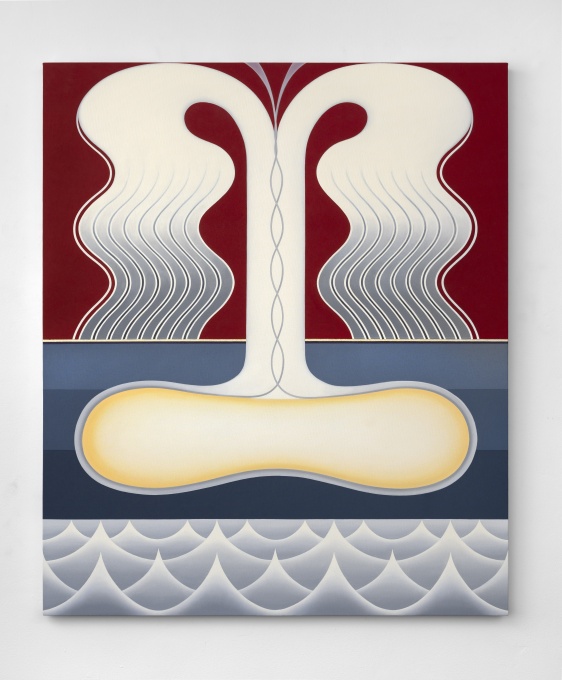
Takako Yamaguchi, Plenum, 2024. Oil and metal leaf on canvas. 50 x 42 inches (127 x 106.7 cm). © Takako Yamaguchi. Courtesy of the artist, Ortuzar, New York and as-is.la, Los Angeles. Photo: Gene Ogami.
While performance is my first “take,” my second concern is how utterly bizarre these paintings are, and at times funny, or maybe witty is a better word. There is a bit of a delay in realizing this, perhaps due to the fact that they initially register as something familiar, as both design and as landscape. But elements bend outside of concrete nouns to a space of in-between-ness. Yamaguchi establishes a logic of clouds, horizon, sea, and land that the viewer might initially accept, but then they realize that the fountain streams turn into marshmallow coils and stripes rain down from braids while gilded potato-esque clouds loom overhead. Each one of these works contains some committedly rendered oddities, only nameable as something-esque or –ish: lifesaver-esque, tendril-ish.
These odd choices do a couple of important things: first, they keep you hooked in the mystery. I often say, and strongly believe, that paintings (and most art) can be read as a series of choices, and it is a great pleasure when an artist makes a choice that your brain would never have thought of, so that you get to experience what it is like to think like someone else. My brain would never ever have landed on “clouds become links of chain,” but I love that Yamaguchi’s does and, not only that, she laboriously commits the vision to paint—literally manifests it to make it be taken seriously. Second, this in-between-ness adds to the complication of swift, superficial reads. While our expectation might be that design motifs and landscape compositions should be easily legible, these works front as such but dance towards something more surreal, emphasizing that to be human is to be multifaceted.
Not only is Yamaguchi’s work displaying a performance and acting as a stage, but it is also performing as a painting itself. Since everyone understands that a painting generally consists of a support, like a stretcher and canvas, and paint on top, then it is simultaneously understood that whatever is being rendered (or recorded or enacted, etc.)—in this case, a landscape—is also simply paint. In other words, you never forget you are looking at paint, even while enjoying the picture. It is a similar experience to theater, where you can get invested in characters and a plot while remembering that it is just acting. These works emphasize the performance of painting and their constructed-ness not only through their symmetry and use of signs like props, but also through their acknowledgement of their frame. All these works appear to be contained within the stretcher’s borders, obeying the boundaries, focusing singularly on the moment within their frame. They are fully on stage, presenting themselves to you. Only Residue (2023) appears like an empty stage where no motif performs, but it perhaps invites the viewer on stage. Or maybe it is more like a moment of anticipation before the show begins.
Similarly, there is a clear choice to hide the brushwork, so that the smoothness throughout these works appears as faux-ness. Again, we know it is paint, but the labor of placing it on the canvas has been erased, akin to watching a figure skater effortlessly complete their jumps, as if hours and hours did not go into achieving the feat. The palette also signals faux-ness, falling in line with colors found in interior decorating that are meant to allude to nature, rather than directly mimic nature, which again drives home the idea of painting playing at something rather than being the thing.
Lastly, I think about Yamaguchi’s use of decorative motifs performing as the natural form from which they were derived and, further, about the motifs as a language in their own right (there is even a work in the show titled Font (2023)). We understand that this is a wave, and this is a cloud, while also recognizing that they might have more to do with design from a specific era or culture than with the natural world. This brings to mind cultural ecologist and philosopher David Abram’s 1996 essay “Animism and the Alphabet,” in which he considers the human move away from reading our environment through animism toward an invented alphabet divorced from original sources (but still animate) that refers to the human-made rather than nature and results in us only listening to ourselves. Abram writes:
Only when those images came to be associated, alphabetically, with purely human-made sounds, and even the names of the letters lost all worldly, extrahuman significance, could speech or language come to be experienced as an exclusively human power. For only then did civilization enter into the wholly self-reflexive mode of animism, or magic, that still holds us in its spell.3
While he intends this as an alarm for our loss of connection to reading and listening to the natural world, it resonates with Yamaguchi’s work in terms of signs that have become detached from nature that she is trying to reanimate in a natural setting. Yet her knowingly ridiculous attempt cannot overcome years of those signs meaning something else, such that we do not see nature, but instead see a human-constructed world. Yamaguchi is pointing to this construction and our general fabrication of self and place through decoration, design, and taste to foreground the importance of the superficial, which is often spoken about negatively but is a tool we use daily to navigate the social world. If humans are caught in a self-reflexive loop of referring back to their own built world, then the construction of this world is worth examining.
Following this thread, I am reminded of the connection between the words grammar and glamour, which once were one and the same, as to know one’s letters (grammar) was to cast spells and charm (glamour) (this circles back to Abram’s point about the spell we are under of our self-reflexive alphabet). Yamaguchi plays with the grammar of decoration and of painting, displaying legible design motifs alongside their strange, less nameable counterparts, performing a world of fantastical glamour that speaks to human attempts at enchantment underscored by far greater complexity.
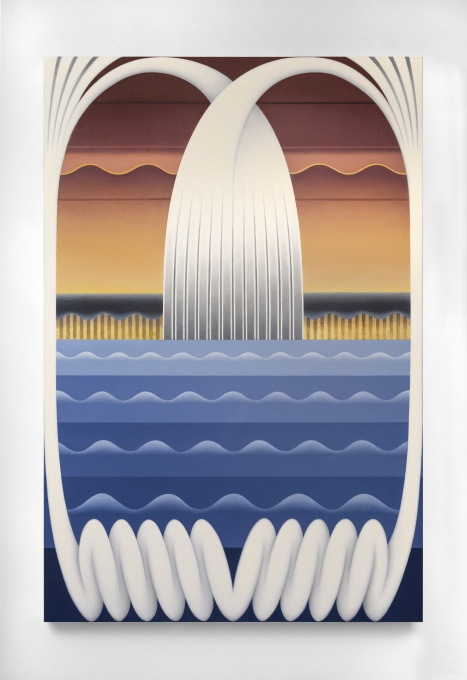
Takako Yamaguchi, Font, 2023. Oil and metal leaf on canvas. 60 x 40 inches (152.4 x 101.6 cm). © Takako Yamaguchi. Courtesy of the artist, Ortuzar, New York and as-is.la, Los Angeles. Photo: Gene Ogami.
Finding / Losing / Finding a Horizon by Andy Campbell
On my first full day as an Angeleno, I took the Expo Line to Santa Monica. I needed, I think, a confirmation that I was here, at the edge of the land that meets the sea that meets the sky. Trekking out from the station, the sand of the beach slowing my gait, deliberate steps made me aware that I had worn the wrong kind of footwear.
Eventually, though, I got to a good spot on the side of the Santa Monica pier, where I stood for a while. Families with their kids, wet shirts stuck to bodies, laughing girlfriends and boyfriends, only a few other loners. Looking out at the ocean and finding the horizon, I became aware of being on the edge of the island that is the continent that I had grown up on.
In my field—art history, yes, but queer studies, too—the horizon means two different things. As Anna Katz relates in her essay about Takako Yamaguchi’s practice: “The horizon is where the world folds. It is the non-place below which everything recedes into depth and above which all else rises endlessly. It holds the flat vertical plane of the sky in endless tension with the horizontal perspectival plane of the land or sea. In short, it is the form of the dialectic between abstraction and representation.”4That is a fantastic distillation of the horizon’s place in articulating a depth of space—connected to early Modern and Modern Western traditions of painting. In queer studies of the past twenty years, the horizon is an imaginary place of enfoldment, too, but one situated in a temporal dimension between past, present, and future. Too many books, essays, dissertations (and I guess me, too) cite José Esteban Muñoz’s utopic formulation of queerness of a horizon of possibility, a promise always, and necessarily, out of reach: “Queerness is primarily about futurity and hope.” Muñoz writes, “That is to say that queerness is always in the horizon.”5
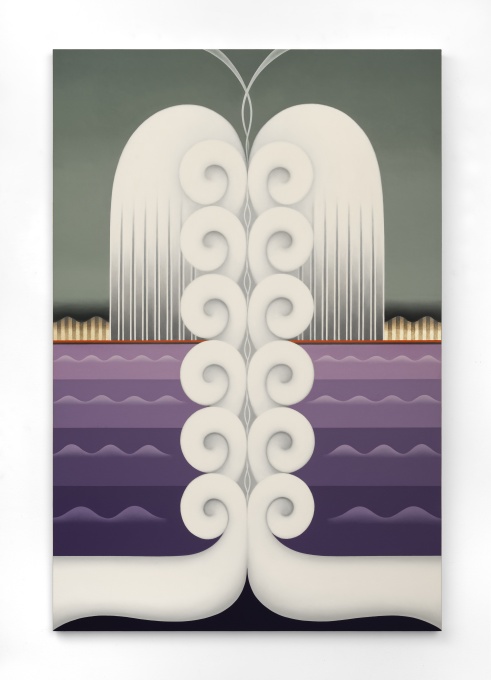
Takako Yamaguchi, Pilot, 2024. Oil and metal leaf on canvas. 60 x 40 inches (152.4 x 101.6 cm). © Takako Yamaguchi. Courtesy of the artist, Ortuzar, New York and as-is.la, Los Angeles. Photo: Gene Ogami.
The filmmaker Maya Deren, in a 1963 roundtable, the edited transcript of which was published in Film Culture, defines a difference between vertical and horizontal montage—which is to say that she articulates a theory around film editing and a conception of how adjacency of moving images works for both the artist and viewer. For Deren, the horizontal montage is the realm of narrative action, scenes placed along a timeline indicating an ever-forward thrust. Vertical montage, on the other hand, is a place of dreams and poetry—its timeline can be aleatory, recursive, unhinged. Images stack and build, bore and drill into the mind, shifting one’s perception of the world alongside a sense of one’s interior. In both the transcript and in the recording of the roundtable, the other panelists—all male, unsurprisingly—ruthlessly make fun of Deren for the difficulty of her conceptual schema. What any child knows by first grade, if not before—that is, the difference between horizontal and vertical—was enough to stump Arthur Miller, Dylan Thomas, Williard Maas, and Parker Tyler.6
Recently, I have been playing with thinking of Yamaguchi’s paintings not so much as seascapes set along a consistent horizon line—as installed in the exhibition MOCA Focus: Takako Yamaguchi—but rather vertical montages (if I might be allowed the creative legroom to transit a cinematic term!). Thinking of them in this way frees me up to notice things about Yamaguchi’s “stacking” of abstracts, and allows me to consider that there is not just one horizon in some compositions, but many.
In Wrapper (2023), for example, a bronze and golden attenuated checkerboard might indicate the reflection of a creeping dimensional dawn.7Here the alternating stripe/check is novel amongst the works as a median horizon line. Then, moving downward, the painting is a suite of registers of coursing purple incursions and zigs and zags. Lavender to deep purple, each with some amount of grey, sapping it of its vibrancy. This recalls, for me, the endless repetitions of a “wine-dark” or “wine-faced sea” named by Homer in The Odyssey and The Iliad, in a time before the color blue was conceptually coherent. It also makes me think of grape soda, maybe because it is something that could be mistaken for natural, but one would have to do a lot of conceptual pretzels to get there. Below these registers (or horizons) is something more akin to the edge of the ocean as it appears when one is standing on a beach (new to L.A.). Here, underneath a subtle sine wave of white foamy crests, are modulated color transitions to light then medium blue. Finally, at the bottom of the Yamaguchi’s canvas is a flat plane of brown—the undifferentiated color of the panel emphasized in opposition to the visual dazzlement above it. In the top part of the painting, clouds and sky are woven into a connected chain of circular forms, hanging like a string of necklaces in the sky. As the sky moves towards the median horizon, the sizes of the circular elements diminish, resulting in a kind of pyramidal alignment in the center, flanked by two aligned “posts.”
Concentrating on the spaces between these circular chains provides a visual destabilization of the regularity of the wave form below. Negative space working negatively. Spatial recession is implied and denied, which is one reason I turn back to the idea of the painting as a vertical montage—a compendium of handy metaphors (depending on the viewer, obviously), for a relationship to the natural world. Jagged paths of purple, an ever-changing decorative sky, reflection and absorption: a wrapper as a form that encloses and excludes, defining edges and the spaces between them. Not one horizon, but, potentially, a dozen or more.
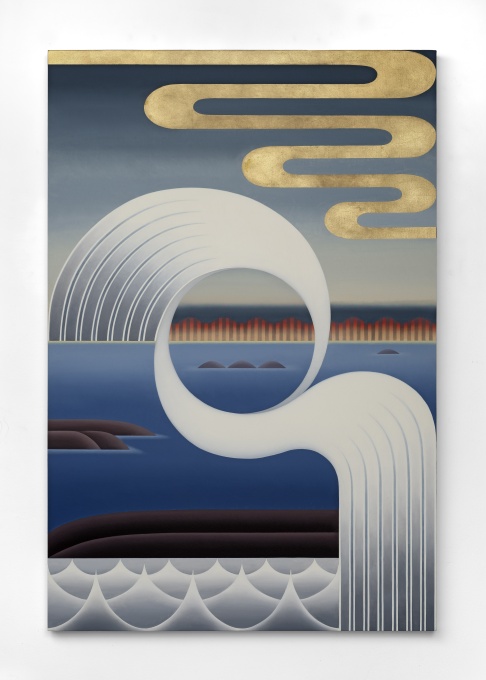
Takako Yamaguchi, Trap, 2024. Oil and metal leaf on canvas. 60 x 40 inches (152.4 x 101.6 cm). © Takako Yamaguchi. Courtesy of the artist, Ortuzar, New York and as-is.la, Los Angeles. Photo: Dario Lasagni.
Or, consider Trap (2024), whose whirlpool-like figural element is both rainbow and waterfall, keyhole and diversion. The articulated strands of this whirlpool possess the same color logic (they darken into gray-blue at their extremities, but at slightly different lengths), and adhere to different spatial logics, one ending at the median horizon, and the other at the bottom of the canvas, their consistent width denying the recession or the procession this key choice would otherwise seem to dictate. The source of these complimentary, curving forms come from sea and sky, respectively, and they both overlap the median horizon. In the middle of the aperture created by their interaction are three dutifully spaced adjacent mounds. Above them, across the median horizon, is a procession of vertical striping—ombre red to yellow, dark to light brown—topped by that sine wave with a dark blue that suddenly transitions to a light, desaturated version of itself (a glimmer of red underpainting makes itself known here), before returning to that same deep blue. Snaking through the top right corner is a rhythmic switchback of gold leafing—a path, a plume, a purposeful counterbalance to the bottommost sharp-edged waves that suggest we reside in choppy waters (highly stylized though they may be). Here I count three horizons, maybe more. Making sense of the various forms and color transitions, we are at once at rest and in motion, at land and sea, forward and backward, surface and screen. A vertical montage of connoted landscape that means danger and safety. The trap is believing any one thing. The trap is the hole in the middle, when it is also the edges. The trap is believing that everything moves towards or comes out of a consistent logic. Yamaguchi’s paintings give us the permission to untie ourselves from needing to know the difference, which is to say that we can formulate an ethics of horizon that need not be proscriptive, but open and free.
I wonder why, when coming to L.A., I needed to see the sea for myself? I think I wanted confirmation that this was a new kind of place. Not Austin,Texas, where I grew up, a landlocked liberal (now libertarian) paradise/hellscape where oak trees point their gnarled arms towards the rolling terrain of hill country; a place where a dammed up river, through collective delusion, could be a lake. L.A was also not humid Houston, where I was in the immediate “pre” to my California “post,”; where the gulf was at a driving distance’s remove but evident everywhere as an invisible cloak of wet, and in swampy grounds that denied any attempt to pave, path, or prune through. In such a place the water comes to you, and when it rains, it floods. I wonder how Yamaguchi knew she was in a new kind of place, when she moved to Maine for college in 1973 from Okayama. And then, eventually to L.A.
I wonder whether she, too, needed to see the sea?
And in seeing it, I wonder what she saw.
In Gallery: Alex Olson and Andy Campbell on Takako Yamaguchi
Andy Campbell: Maybe the first place to start is with performance, which we both mentioned. Why do you think we both went there?
Alex Olson: I think we were both drawn to how edges function in the paintings, or maybe transitions is a better word. I often think that paintings are dictated by how elements transition between one another, in other words by the edges between things. Here, the crisp edges of the motifs suggest distinct surfaces like cut-outs, as if playing at landscape through layering rather than obeying spatial, perceptual rules, such as soft focus to indicate distance. When we look at Residue, my first thought is that it feels so anticipatory, like a stage is being set, and also that all these motifs have been laid out to begin some kind of dance or a performance of interpretation and language.
AC: –and that they repeat. One of the things you discussed was how ideas become language, and then, because of its repetition, it becomes cognizable, or knowable–and that’s true with these decorative elements that recur. You think of that as a stage set, which I think is brilliant, because it anticipates an action.
AO: You got to performance through editing. How do you see these vertical cuts, these multiple horizons, in relation to performance?
AC: I think it’s a way of making the paintings a little bit unknowable. If you change the logic that you initially use when you look at the paintings–such as thinking along this median horizon line, which is articulated also in the way that they’re hung in the gallery–and start interacting with them as components of a horizon, then that is a way of getting into them, of playing with how far, spatially or distally, you are from what’s going on with the forms inside the paintings. There’s also a way in which Yamaguchi constructs these forms so that they anticipate, but escape, my naming and description. These forms become motifs, because they appear in the painting over and over again. They seem familiar but not quite, they are always eluding our description of them. The artist is in a performative relationship with us as a viewer: she’s asking us to both acknowledge these forms and complicate them.
AO: It’s a motif performing as something knowable, like a wave. But then it’s like what happens when you’re watching an actor–you’re thinking, “Okay, I buy that. You’re a wave right now. But you’re not really a wave.”
AC: –“You might be so much more, too. You’re a wave and…”
AO: –“And you can turn in a second and do another kind of performance, if I just put you vertically…”
AC: It is as you said: wave is rising, curtain, wave is descending, curtain. I think that gets precisely to “it’s a wave and…”
AO: I like the “and.” I like the “more” rather than the dichotomy. These are anti-dichotomous paintings.
AC: And that’s right, because, unfortunately, abstraction and representation often get framed as a dichotomy. You have an interesting way of thinking about that, can you talk about it?
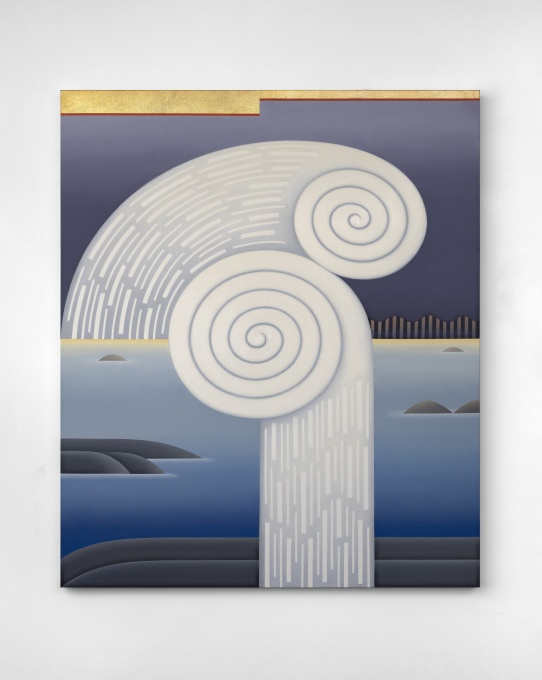
Takako Yamaguchi, Accomplice, 2025. Oil and metal leaf on canvas. 52 x 40 inches (132.1 x 101.6 cm). © Takako Yamaguchi. Courtesy of the artist, Ortuzar, New York and as-is.la, Los Angeles. Photo: Dario Lasagni.
AO: The terms abstraction and figuration get thrown around as if everyone agrees on what they mean, and I don’t think they do at this point. I see these concepts as happening simultaneously: it’s less like a dichotomy and more like the spectrum of language. When something is called figurative, it lands more in the realm of nouns–concrete, solid nouns, like, “Oh, that’s a wave and nothing else.” Whereas when it starts swinging into what’s considered abstraction, it’s more in the land of the “and” or the verbs or adverbs, so there’s a little more movement, perhaps. How do you understand abstraction?
AC: There are lots of ways of getting to or starting from abstraction. We know so much about the way that artists make work at this point that to say any one path leads us to abstraction firmly, resolutely, is to ignore something else. The question is more how abstraction, rather than what abstraction: how did we get here?, or how did we start here?, rather than naming what it is or what it is doing. And, I’ll add, that’s a difficult position to take in terms of abstraction vis-à-vis a viewer, because the how is not always immediately apparent. Accepting this admits that a key part of abstraction (and indeed, part of representation if we’re not building dichotomies!) is a perforce opacity.
AO: It’s more about the thinking process and the choices.
AC: The choices! If you look at Yamaguchi’s early work, you get this sense of a progression towards and away from different kinds of painting strategies. That’s how artists work over the course of their lifetime–that stuff shifts. And so here we are in this most recent period in which Yamaguchi is creating works that both look like transcendentalist painting and which might only cursorily relate to the way that she was painting the body (the figure) previously. When we’re talking about abstraction or figuration and figuring out either one of those terms, we have to connect them to the artist’s broader journey, the broader body of work.
AO: You brought up transcendentalist painting, and Anna Katz mentions Agnes Pelton in her essay in the exhibition catalogue. Yet that work wasn’t in the popular consciousness until recently. This brings up how Takako is always a contrarian, not concerned about the popular or the dominant voice of a time, and really trying to work against it. I doubt that she was looking at transcendentalist art while making her work, but transcendentalist art feels relevant now.
AC: We can think about these paintings as seascapes, as Takako talks about them in terms of Romantic painting. That is a space where artists have projected different kinds of relationships to nature, some of which are about being overwhelmed by that experience (that’s the Romantic sublime). However, in a painting like Procession, there’s a boundedness. So it looks like she’s using forms very similar to transcendentalist paintings, but one of the ways in which she differs is, transcendentalist painters go out, and in Yamaguchi’s work there is often a designed order, making them seem, perhaps, a bit more bounded.
AO: I agree. These are not about awe in any way. I think it’s because they never give you an expanse. They just keep reiterating surfaces, so not only are they bounded, but you can’t even go into them.
AC: That very flatness is also one meaning of the vertical horizons, because they let you stay here and look at all of them at once. You’re not necessarily going in.
AO: When we spoke earlier, we both talked about how we didn’t hear sounds when we looked at these paintings.
AC: Yes, the sonic event of these paintings came up for both of us separately. If there was a sound that would be associated with them, it was either no sound or something very low and thrumming or humming.
AO: But sound is obviously very different from language. You can have language without sound, and I don’t think that these are mute in any way.
AC: No, but there is a stillness. Even when you’re looking at something that might signify choppy waters or waves–if we look at Procession, at these dynamic waves–because of their regularity, there is a kind of stillness. The dynamism is overtly crafted, minimizing the sense of improvisation (though, as we know, Yamaguchi does not pre-plan her paintings!), and that lends to this quality silence that you describe. Silence is one word for it, or a kind of stilling of the mind. This is one place where abstraction sometimes goes.
AO: She’s not choosing to be silent, these aren’t silent. I read these paintings. Her motifs and all the gestures are done with such conviction, in an “I am to be read” mode. Where there are moments, like in Font, of this form becoming a marshmallow, that is where the work goes into the slipping of language, and that is about nuance. It is about testing our ability, our desire, to place language on everything and to know things fully. And the fact that you can’t know these fully is one of their powers–and something I really believe in, as a value.
AC: That is precisely what I end up telling my students what the value of art is at this very particular moment in time. Unknowability or slipperiness is something which really everything seems to be working against today. The experience of sitting with something that you do not know, that you will not know, but you still want to sit with, is a deep value. Yamaguchi, in this way, and in many others, is an excellent teacher.
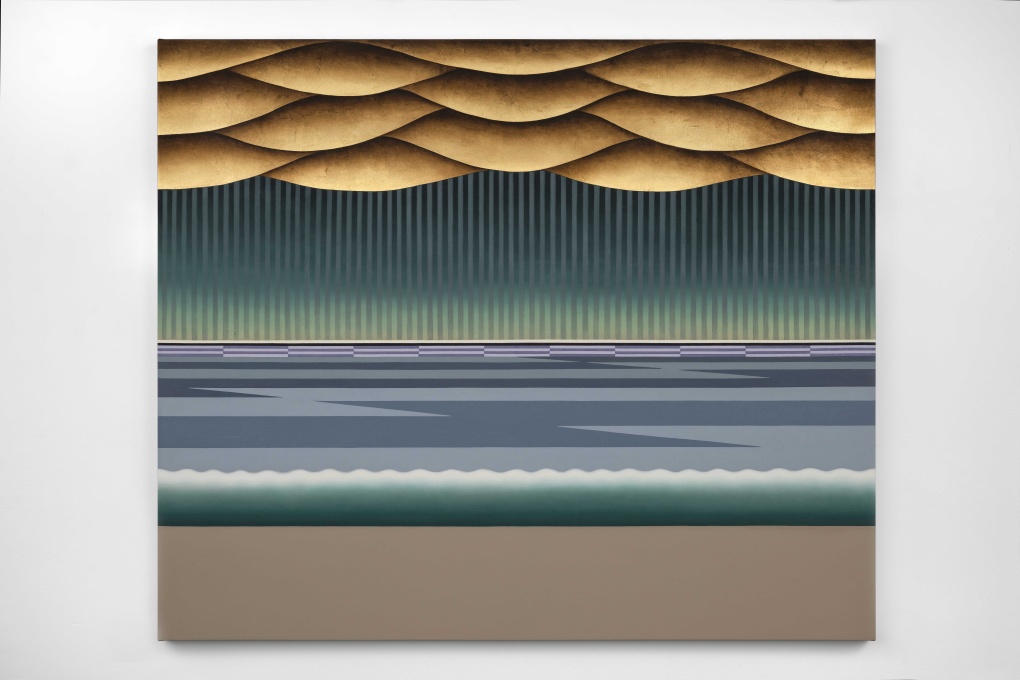
Takako Yamaguchi, Residue, 2023. Oil and metal leaf on canvas. 42 x 50 inches (106.7 x 127 cm). © Takako Yamaguchi. Courtesy of the artist, Ortuzar, New York and as-is.la, Los Angeles. Photo: Gene Ogami.