Between Art and So-Called Life: On Lenard Smith’s Fortuitous Encounters
by Georgia Lassner
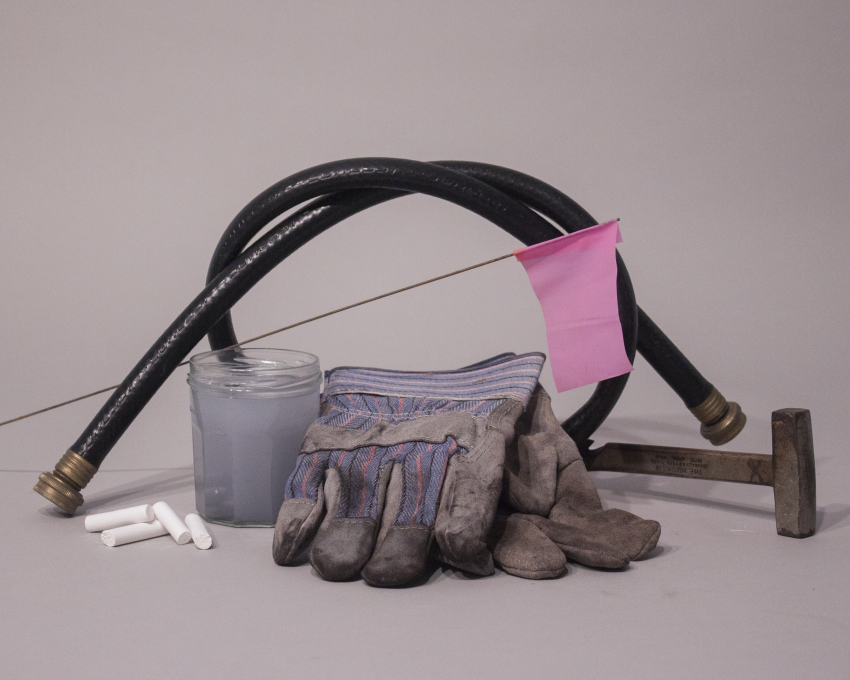
Lenard Smith, Composition #682, 2020. Archival inkjet print. 16 x 20 in. Courtesy of the artist.
Before there were any children, there was a fantasy. It had something to do with the expansiveness of Los Angeles—its hot, cloying, almost kinetic vastness, which we took for a kind of emptiness—a sense that space was waiting for us, if only we could take the garbage out of it, or paint it, or put enough potted plants in it. It had something to do with art; it was a thing you could give to an artist. It had, quite crucially, something to do with writing, and with conversations, and with writing about art—with writing about the artists who needed what you had—your hot, empty space among a million possible empty spaces. It had something to do with the need for words to fill what we mistook for emptiness.
It was a long time ago and it’s harder to remember than I expected, but we took out all the junk—the old broken furniture and the sagging boxes labeled sentimental and the bent beach tent—we took it all out and did god-knows-what with it, but left the the mini fridge, the gray flat file, that long, high work table that I built out of plywood and finished with shellac and added casters to (I was always adding casters to things!). Yes, it was a long time ago, but from 2018 to 2020, we conjured a version of our fantasy: we hosted four artists in the emptied-out one-and-a-half car garage in our backyard in Northeast Los Angeles, and Lenard Smith was one of them.
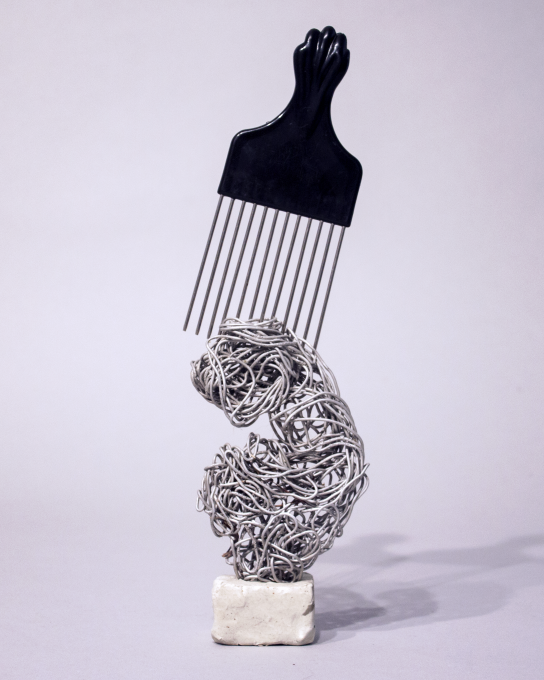
Lenard Smith, Foundational Roots, 2020. Archival inkjet print. 16 x 20 in. Courtesy of the artist.
(Long, possibly meaningless parenthetical coming: there was a lot more to it than that. Like, a lot more. That’s the writer’s curse. Is it poetry, or is it a story? Is it beautiful, or is it about something? Is it language, or is it a description? Sometimes when I re-read myself I want to just PUNCH myself for the mystification of it all. Let’s try the stripped-down version. The ugly version? Or just, The Truth: it was 2018, I was two years out of grad school and working at CalArts. I badly wanted to be a writer but could not get anything published. I had started a WordPress blog, called it unpublished,1and just wrote and wrote and wrote, about art mostly, and about myself, unable, often, to tell the difference. My job at CalArts was ostensibly to be a note-taker, sitting in on the faculty critiques of student exhibitions known as “reviews.” I was, simply put, a listener—something I don’t think I was cut out to be. And yet I listened and typed furiously, I added narrative where bullet points would have sufficed, I gave detailed descriptions of artworks no one asked me to elucidate, I double-checked the art-historical references and corrected titles and would sometimes add additional research topics for students, unsolicited. I finally published a real article,2in X-TRA Volume 21 No. 1, in the same issue as Leslie Dick’s now infamous Soft Talk: Thoughts on Critique3and it was just as if I had finally accidentally on purpose become something I had wanted to become. I was greedy to write, to discover, to own, to take ownership of, and so I invited artists to use my Highland Park garage as a workspace, for free, as long as they agreed to meet with me and tell me things and I suppose listen to me, which made me feel alive, and made life, for which art had become the only cure for banality, meaningful. I wanted my life to be meaningful and special so I did the least I could do which was convert my garage into a workspace instead of just letting it accumulate junk. Lenard and his girlfriend Lauren were splitting the studio space when COVID happened and we shut it all down. We did not get to host an open studio or a party, and I did not get to write about Lenard’s work. I remember the day Lenard moved out—he had on these severe-looking black latex gloves and I watched him through the window, moving his things out one by one. Things were ending and things were also beginning. The garage is filled up with junk again, and I have six bylines in Artforum, and a five year old son. I didn’t want my writing about Lenard to end up being writing about me, and it’s possible, if you’re very very careful, but then again, it’s always been hard to tell the difference, between the art, and me. But let me try again.)
Lenard’s presence is so serene you could brush up against it and mistake it for the breeze. When I met him, in 2019, through mutual friends who suggested he apply for the residency (use of the garage was strictly need-based, not merit-based; it meant you had to be in need of a studio. That was the only criteria), it had been over a decade since he’d graduated from Bard College with an MFA in Advanced Photographic Studies. He had no gallery representation or collectors. He had a few cameras and tripods, a few backdrops, many, many books, and a long-standing photography practice as serious as a heart attack. Recently, I spent the day with Lenard. Lenard is mystical and magical and friendly and fun to talk to. Lenard is smart and thoughtful and good at describing complex ideas in a way that’s like a lullaby. He’s the kind of person who doesn’t use filler words. This leads me to believe he is comfortable with pauses, with silence. I want to be like that. I recently spent the day with Lenard and we began in a coffee shop, drinking iced tea and eating bagel sandwiches. (It is not fair to make an artist into a magician, to call him mystical and magical and make him more than human. Lenard, I assure you, is human—hence the tea and the bagel sandwiches). On this day I learned so much about him. The way he doesn’t allow objects to stay “idle.” That a teabag, to him, is poetic. (This I didn’t learn that day; this I could tell from looking at his pictures). But there is a lot of history, a lot of places lived and cameras owned, a lot of relationships built and time spent practicing as an artist, which may seem obvious, but is certainly not universally true. In 1998, when he would have been 23 years old, Lenard moved to Italy. He wanted to find a place to go to learn a new language and gain new cultural experiences, he was interested in the architecture and the history—and he was immediately confronted with what the African diaspora looks like—he called it “a plethora of Africans” with more people represented than he could even count. “It was the same old bag, refugees looking for opportunities and selling fake Gucci bags, just the same as New York.” Lenard describes his time in Europe as “being there to live.” He was actively making photographs with a 35mm camera, a medium format camera, and a super 8 camera to shoot moving image. After that he moved to London and stayed with family; he got a bank account and a work ID so he could have a job. He researched all the museums of London; he saw Nan Goldin’s Ballad of Sexual Dependency at Whitechapel Art Gallery in 2001 and can still remember crying. Not long after, he saw Wim Wenders at Haunch of Venison and that’s when Lenard knew that he, too, was going to pursue photography in a different way. But even before London, Lenard was looking for what Black photographers were doing—the documentary photos of Gordon Parks—Robert Frank’s Moving Out4was one of the first books that held Lenard’s attention—the artist was always on the road, experimenting with text over image, experimenting with a diaristic point of view. Lenard visited Berlin and made a series of architectural images called 16 States (he wanted a title that sounded more clever than just Berlin). He was developing his sensitivity towards theory, and the inspiration to observe his surroundings. He was naive to the theory of the architecture itself, which gave him a kind of freedom. He was trying to make photos that took the craft seriously. Even in pictures from twenty plus years ago, you can see his language—how things are situated, how things are navigated, how to navigate through this world. (“It’s still my story,” he told me). Even before Italy, Lenard made black and white street photography in San Diego. In 2001 he flew to Ghana for the first time to attend his grandfather’s funeral in Accra. His grandfather was a police commissioner, and his funeral was a week-long open casket observance with round the clock police security. Lenard made hundreds of photographs in Ghana. Referring to one he made of a server holding a silver platter at one of the funerary events, Lenard said, “It resembled the history of America—the servitude and the plantation history.5But he did his job with such dignity—even the posture of the hand holding the silver plater, and the way his gaze is unflinching. It’s the way he looks back at you, he’s not joyous, he has a face I could have never directed him to have made—moments of having to confront my own cultural identity.” He remembered visiting Elmina Castle and Cape Coast castle, the famous “slave castles” of Ghana, and the “door of no return”—the final door slaves were forced through before being loaded onto ships bound for the Atlantic. After Europe Lenard briefly returned to San Diego in 2003, and then moved to New York in 2006. There he started to engage with portraiture and the idea of the tableau, directing encounters with strangers. He took photographs in Harlem, wanting to engage the history of photography through people that looked like him. He met a black woman living with albinism and invited her to his studio to make portraits.6He wanted to make portraits that were imbued with sensitivity to everything about the subject—not a “by-chance great photo,” as Lenard called it. He applied to Bard College for an MFA and studied there from 2006-2008. Lenard did not have an undergraduate degree but was accepted based on his breadth of experience. His most important work from that time was a series shot in a nursing home in Rockaway, Park Nursing Home (2007).7Lenard was given permission to photograph anything in the nursing home, except the people. It was about access and empathy, and care, and the idea that things were waiting for him to photograph. Every detail was meaningful to him, down to the screws that held the artwork on the walls, so that residents couldn’t pull them down. He left New York for Los Angeles in 2014 and it was then that he started to self-publish his books of photography, showing them at the LA Art Book Fair. He pulled away from portraiture and was driven to the studio atmosphere. His books mixed objects, portraits, and interiors, trying to find a common thread of language between the pictures. Books were also a way of archiving “loose” images that didn’t fall into a series. For more than twenty five years Lenard has not stopped taking pictures. The work on view in Fortuitous Encounters was made between 2018 and 2022 and all but one artwork has never been on view before. When we first sat down for bagels and I asked him, somewhat naively, for a summation of what he had been doing before he started my garage residency in 2019, he said simply, “I was an artist navigating space, living with objects, and making art with those objects.”
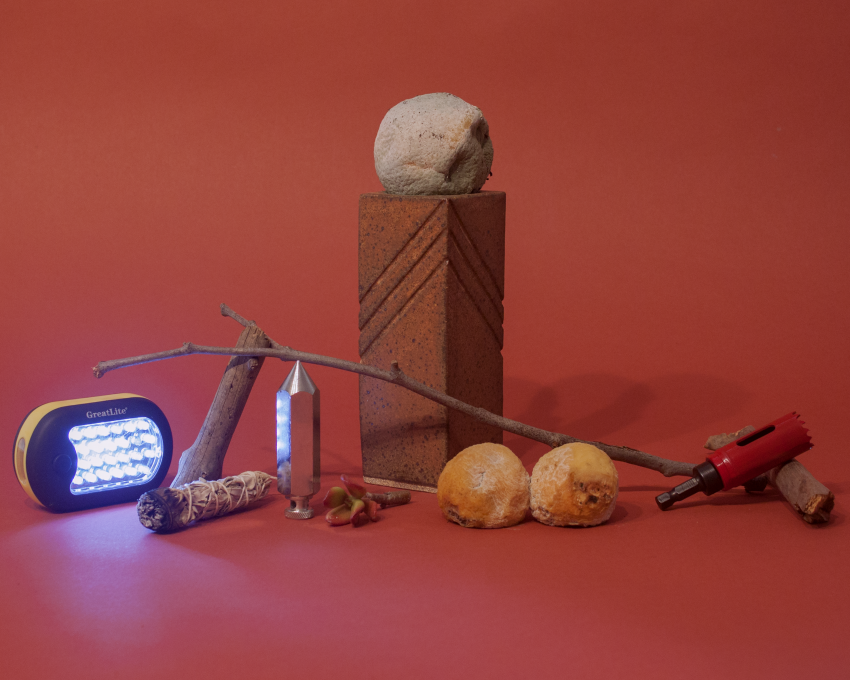
Lenard Smith, Composition #812, 2020 Archival inkjet print 16 x 20 in. Courtesy of the Artist
Now Lenard is a professor; he shows with the same galleries as renowned artists like Mark Dion;8his work is in the permanent collection of LACMA, in the Wallis Annenberg Department of Photographs.9He has published many books, and has even become a parent, like me. And yet none of that, absolutely none of that, has anything to do with the immense and implausible feeling of entering an exhibition to find, depicted, as contemporary art, one’s own private possessions. But there they were, in Fortuitous Encounters, Lenard’s debut institutional solo exhibition at the California Museum of Photography—my things: a cracked ceramic duck, filthy work gloves, a half deflated mini basketball—even the rotting lemons looked, somehow, like they belonged to my tree (they did). An uncanny combination of surprise and obliteration—a brand new, absolutely never-before-felt feeling I did not know art could conjure—a rush of recognition and misrecognition and awe and even confusion—there were a lot of feelings, but also, so, so much to look at. And so much to describe, which for me gives Lenard’s work a linguistic turn, even though it is so plainly structural, with all its delicate, precarious leanings, its unlikely pairings, its formality and pretense of formalism.
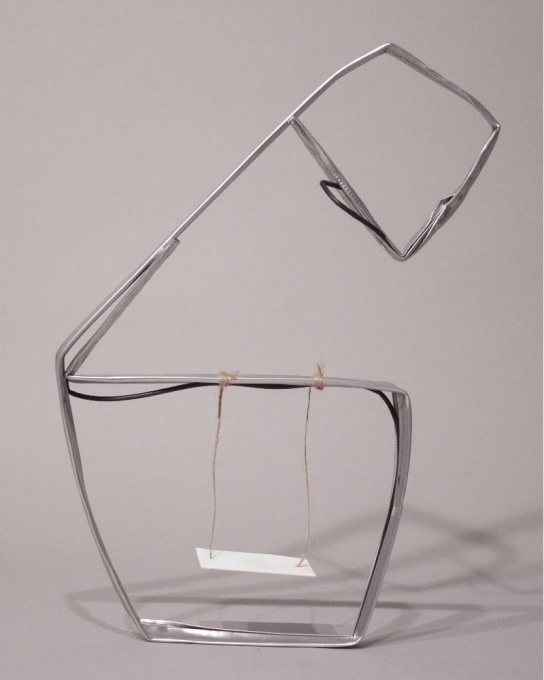
Lenard Smith, Hermon’s Swing, 2020. Archival inkjet print. 16 x 20 in. Courtesy of the artist.
The 38 (!) artworks of Fortuitous Encounters take up exactly one gallery, and one exterior gallery wall. They are hung in groupings, of either one or two rows, based on two distinct bodies of work: the titular Fortuitous Encounters (2018-2020) and Melancholy Objects (2022). The exterior gallery wall presents seven photographs from Fortuitous Encounters, and a sculpture; it’s the object from Hermon’s Swing (a photograph that appears later in the exhibition) sitting on a peach-painted pedestal. This untitled object is off-checklist; it looks like a thin piece of metal twisted into a strange and curving armature from which hangs a tiny swing, perhaps made of string and cardboard. There is a pervasive shadow, almost an off-putting darkness, at the outer edges outside of the gallery, and it is into this sightline that the sculpture is placed. When I first walked up to it I did not understand its purpose and mistook it for ephemera. But really, no moment in the show was missed to evoke staged-ness, or to draw the audience into a ponderance of the photographic process. Whereas ephemera serves as documentation or context, the inclusion of this object loosens the idea of mediation a little, lightly disputing if there is more truth to the object than to the image, if one makes more meaning, or holds more authenticity, or more power, for that matter. Hermon’s Swing doesn’t belong to me, I think.
As far as the other objects depicted go, some things I recognize as mine—and some, I do not: a mini yellow LED worklight from my tool box; the salt-glazed vase my wife and I bought from the Perkins Cove Pottery Shop after our wedding a decade ago; a metal plumb (the kind for building); a piece of jade (the plant, not the gem); a huge red drill bit with teeth set to cut perfect circles; the basketball; the lemon grabber; the triangular engineer’s scale; the razor blade; the piece of chalk; the white rectangular trash can placed on its side. And the other objects in the images? If they are mine, I no longer recognize them. And then I think, mine? What is the meaning of mine? There were no established criteria for what Lenard would make during the residency, which was intended to be a full year, but ended up lasting only five months. I knew that Lenard made artworks from other people’s belongings. I even wrote about it in a letter of support for him from 2021: “In Lenard’s studio practice, he uses found objects (sometimes his own, sometimes those of others) to create contemporary still-lives that reference master still-lives. These intriguing photographs create open-ended narratives that speak to both the life of objects (an errant work glove, a crinkled leaf, an unidentified plastic object) and objects which could be codified as relating to Blackness and its meaning, such as certain cassette tapes and textiles. Having spent so much time in proximity to Lenard’s work and his studio, I know how vigilant, dedicated, and serious he is. Lenard spends copious amounts of time creating studies for works, gathering objects, and getting everything just-so. His attention to detail, both in his work and its preparation, is awe-inspiring. I am in full support of any opportunity that allows Lenard to focus his time strictly on his artistic work, and I will continue to support him as an artist in any way that I can.” I knew Lenard had photographed my ceramic duck that was split in two when I had my second-story gutters cleaned.10I just didn’t realize, or somehow didn’t understand, that he had created an entire body of work from my objects. Would I call them found objects? That can be a semantic or a conceptual question. To me they were not lost. Is there an intermediate word for using objects in this way? Borrowed objects? Part of me wants to call them stolen. Generally speaking, one needs to consent to their portrait being taken, or it’s not really a portrait. But one’s moldy, wrinkled lemon? The idea of consent seems preposterous. I know the writer forgets the difference between themselves and the artwork. I know that.
I am opening my mind. I am stuffing my hand in my mind and squeezing until the little bits of thought become bulbous and translucent. I am trying to think beyond what I think. I am trying to think beyond what I think I think. Lots of Lenard’s objects somehow infiltrate what I think of as mine—a Polaroid camera, paint-caked black latex gloves, an archival box, a sculpture which is a red ribbed sock with a big toe poking though the end of it, some sardines, a small photo of the rapper Rakim wearing a jacket designed by Dapper Dan (had to Google that) and featuring the Universal Flag of Islam, a busted up cellphone screen, and lots of other things, too. When writing about art, one of the challenges is to describe what’s there, to convey it, to make the reader see it; but the sheer number of objects in Lenard’s pictures—all the different colors and references and meanings and possibilities—they resist conciseness, summation. Yet simultaneously, each photograph appears sort of simple and legible, an arrangement, a decorative position, perfectly set and framed and captured, inert and beautiful, mysterious but familiar, sometimes defying gravity, sometimes banal. Am I part of this?
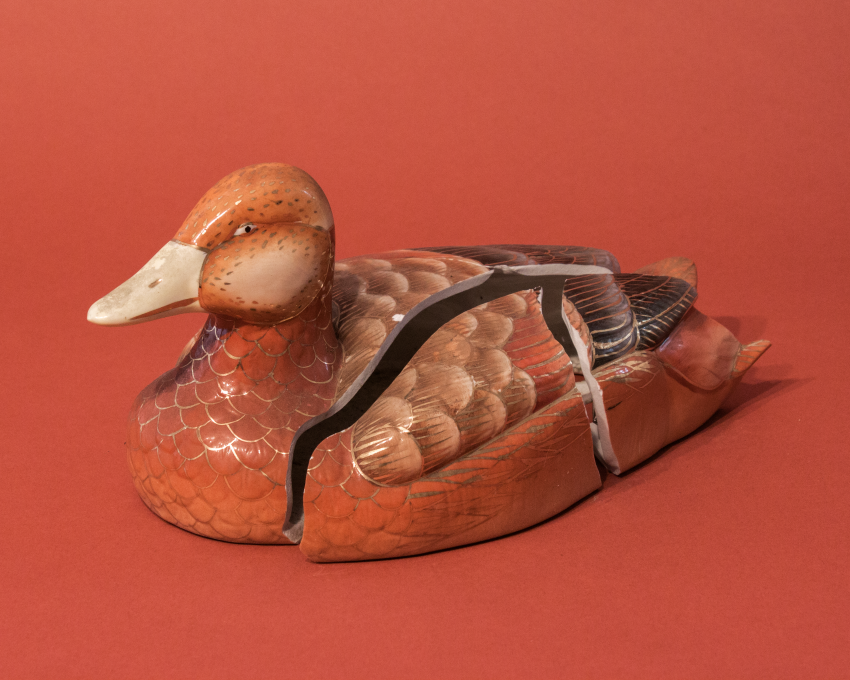
Lenard Smith, All of Us, 2020. Archival inkjet print. 16 x 20 in. Courtesy of the artist.
Deeper inside the gallery, I am drawn toward All of Us, the photograph of my broken handpainted ceramic duck, which is very close in color to the orange backdrop it’s photographed on. Like I said, I had already known that Lenard photographed the duck—I had seen a version of it in a show before. And I knew Lenard’s practice was about photographing things. I just didn’t know so many of them were my things. Over and over I asked myself if it was a mistake to see the individual objects, and then I asked myself if it was a mistake to see the individual artworks, and then further if it was a mistake to see the individual bodies of work, and then I thought, how can seeing be a mistake? A hose piece, a bundle of metal brushes used for removing rust on tools (that’s what I used them for), a weird hammer/crowbar/bottle opener I picked up at a yard sale, a bundle of tassels tied in a gentle loop11(those belonged to my grandmother) draped over a rectangular upside down silver metal mesh pencil cup, a mini green propane tank for a camping stove that my in-laws left behind, wiffle balls for growing orchids. I saw, quite literally, a lot of myself in these pictures, and I didn’t know, exactly, what to do with that. For some reason I kept thinking mediation was the key—how to separate myself. How not to see things. I was a walking manifestation of the type of modernist universalism whose unlearning is critical to maintaining any credible contemporary position, and yet I kept thinking, my subjectivity is blinding me. But was it? Does it?
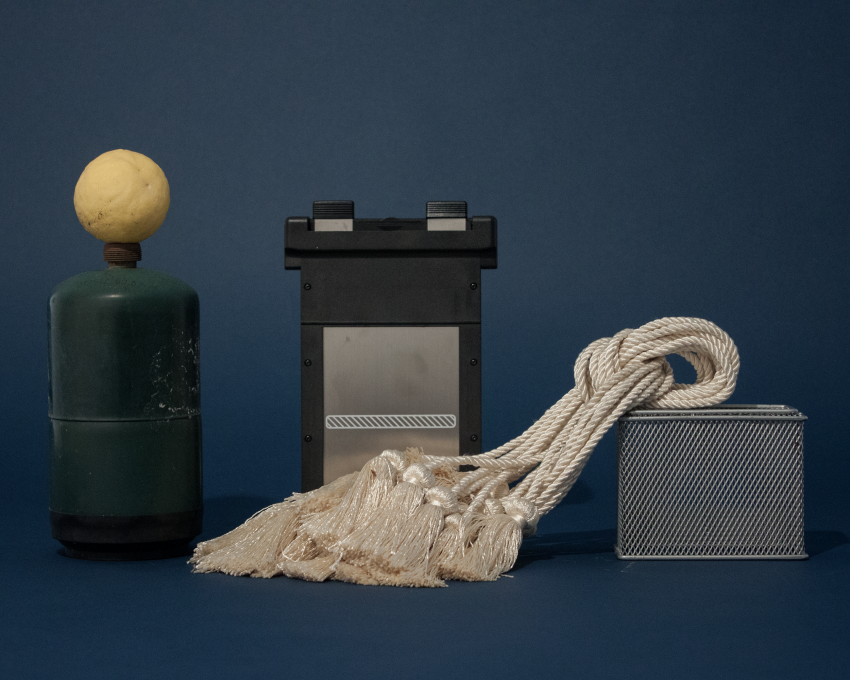
Lenard Smith, Composition #473, 2020. Archival inkjet print. 16 x 20 in. Courtesy of the artist.
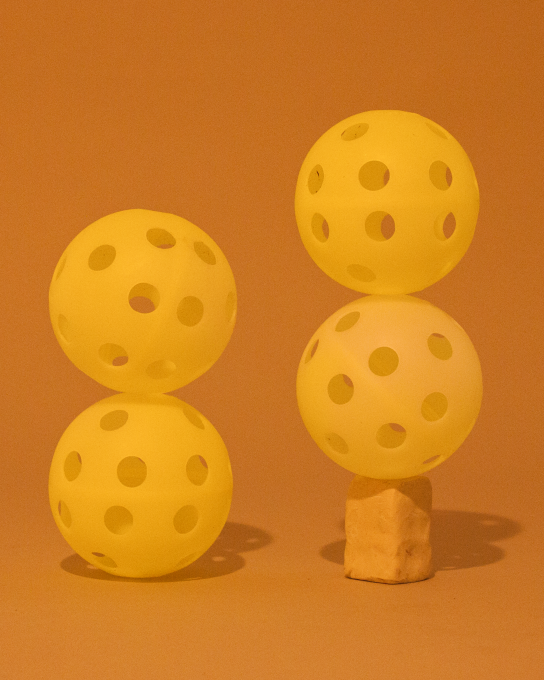
Lenard Smith, Study for Spheres, 2020. Archival inkjet print. 16 x 20 in. Courtesy of the artist.
Thankfully, I also saw lots of not me. Camera parts I don’t know the names for, an Afro pick (looks vintage) set atop a few rocks (possibly from my yard?) leaning against a draped piece of gold fabric, which has a wire hanger placed delicately across it (so beautiful! So light and angular yet also curvy!), and then a tuft of what could be hair but also a pile of soft lint, or even a delicate sponge. I don’t think the gum or the sardine can was me, or the paper airplane, but maybe the clamps? The matches could be anyone. There was something that looked like a hunk of yellow cheese but is probably yellow modeling clay. Is it possible that Lenard’s photographs became less “legible” and more “metaphorical” as they became less and less me? As I recognized less and less of myself inside them?
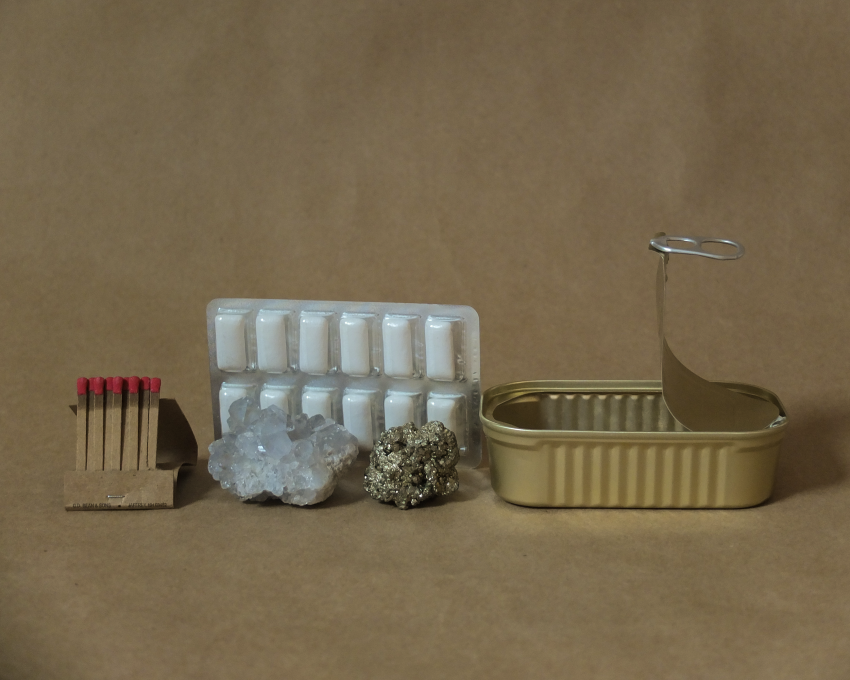
Lenard Smith, Composition #375, 2016. Archival inkjet print. 16 x 20 in. Courtesy of the artist.
Much of Lenard’s work relishes in a kind of transpositional wizardry—how does he make a tripod look like a person? How does the Afro pick balanced on a clump of something silver on a hunk of something white also look like a person? How does a piece of twisted metal look both like a person and like trash? How can an old black umbrella on top of a sewing machine (mine) look like a person and a sculpture and an illusion? Then there are the actual, three-dimensional objects displayed at different, almost random heights throughout the show; some of them exist first in the pictures and then materialize, like the metal swing sculpture and Afro pick, and others seem arbitrary. It almost feels like some of the images cannot contain themselves to the frame and must jump into life, while others have manifested into the gallery but with no photographic trace—ghosts. For my part I seem to be having an opposite reaction—projecting my real objects into the images, confounded at their utter banality and great, great power.
Each series seems to express its own moment, its own set of ideals—for what a picture can be, what an object can be, what kind of balance, metaphorical or otherwise, can be achieved, or even captured. Nothing in the images looks provisional, and yet we know they are there for the purpose of being photographed. Sometimes I would stare hard at the photographs, as if looking at—for—my own reflection, and they would seem to stare back at me; somehow I both recognized what I was looking at, and did not. Life can be like that, zooming in and out of legibility from moment to moment. Like when you receive a horrible diagnosis, rendering life unrecognizable, but forcing you to perceive the good moments in a way that wasn’t previously possible. Or when a child is born, and you see that they are an iteration of you that you recognize, but also find completely unfamiliar, alien.
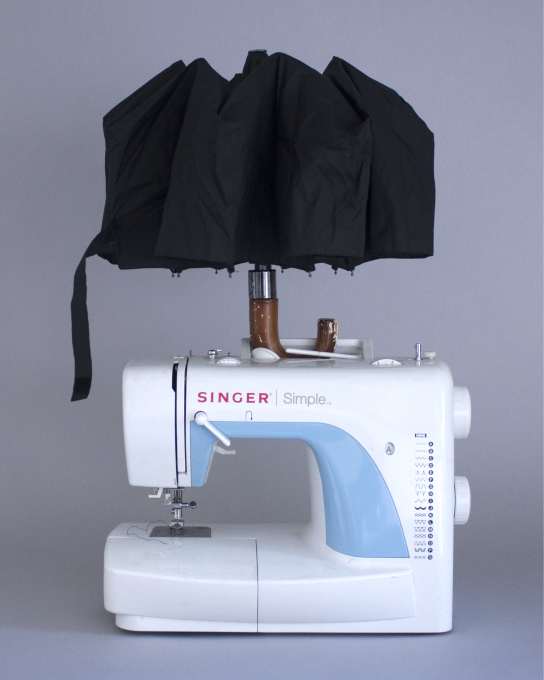
Lenard Smith, Fortuitous Encounter, 2020. Archival inkjet print. 16 x 20 in. Courtesy of the artist.
Lenard’s work is flowing with metaphor if you know where to look, and if you want to see it. Representation abounds (need I describe more objects here?), but the work’s content lies so much in the way things touch, balance, lean on, stick into other things, or, in the case of my ceramic duck, break. And in those relationships to the representations of self woven throughout the Fortuitous Encounters show—objects of Black culture and representations of Black people that have been unwanted or unrecognized in art’s most valued, Western forms. The horizontal versus the vertical, as in, the landscape versus portrait orientation, (the most introductory of art language) is used to maximum effect, denoting its traditional use but also subverting, asking more from it. Hands, feet, hair, things that look like heads—to see these works as formalist is to forget that things mean something. It’s almost Victorian, the way Lenard captures images—I want to call it clairvoyance, but maybe it’s more like experience, or curiosity, or patience, or kindness.
As we know, Lenard opted to group his works into series, and to title each series either directly or obliquely after Susan Sontag, whose 1977 book On Photography is not only regarded as one of the most important theoretical texts written on photography, but is genuinely thought-provoking and interesting—something many highly-regarded theoretical texts are not. And while everyone loves a good art historical reference, each phrase can live on its own—one need not have read On Photography (but you could! You should!)12for those titles to contribute to the richness and complexity of Lenard’s work. In many ways I feel the exhibition was titled just for me—the most fortuitous encounter-er, the experiencer of reverberating juxtapositions, of the past and present and the owned and not owned and the recognized and unrecognized, and the lost. Lenard’s residency in my garage ended when COVID started, and I never got to do that thing that was part of the fantasy, to give his work language and fill voids I thought only words could fill. I don’t misrecognize Los Angeles as empty or mine-for-the-taking anymore, and I don’t have any space to give anymore. I no longer write to fill anything, but to open something—or as Lenard might think of it, not to capture, but to propose.
At the other end of the museum, set up in front of the concrete balcony that overlooks the downtown Riverside plaza called Main Street, is a little table set up with pieces of styrofoam, cardboard, pipecleaners, and colored pencils. These are supplies for making your own so-called “assemblage sculpture photographs” by building little sculptures and photographing them in a miniature light box, just like Lenard. I think of this hands-on activity as a chance to feel what it might be like to be Lenard—more an act of embodiment than production—more mystical than technical. I chose a styrofoam rectangle and a pink pipe cleaner, weaving it around the block and placing it in the lightbox. I then leaned a triangle against it, trying to create something relational, like I imagined Lenard would. It’s not so easy, you know, to make art, to make a photograph, to make an accurate representation of anything, really. Sometimes even words aren’t enough, but we do try. The still life in the light box reminds me that we are all just setting up and waiting— for our own moment of conveyance, our own objects to balance. By the end of this essay I wanted, so very badly, to understand something about art and perspective and objects that still seems out of grasp. I wanted to understand if it was transgression I felt, or love, but I do not know. You don’t need a writer to tell you that life is a despairingly consistent blending of both. I’ll take this last gift, again: I was an artist navigating space, living with objects, and making art with those objects. It’s still my story.
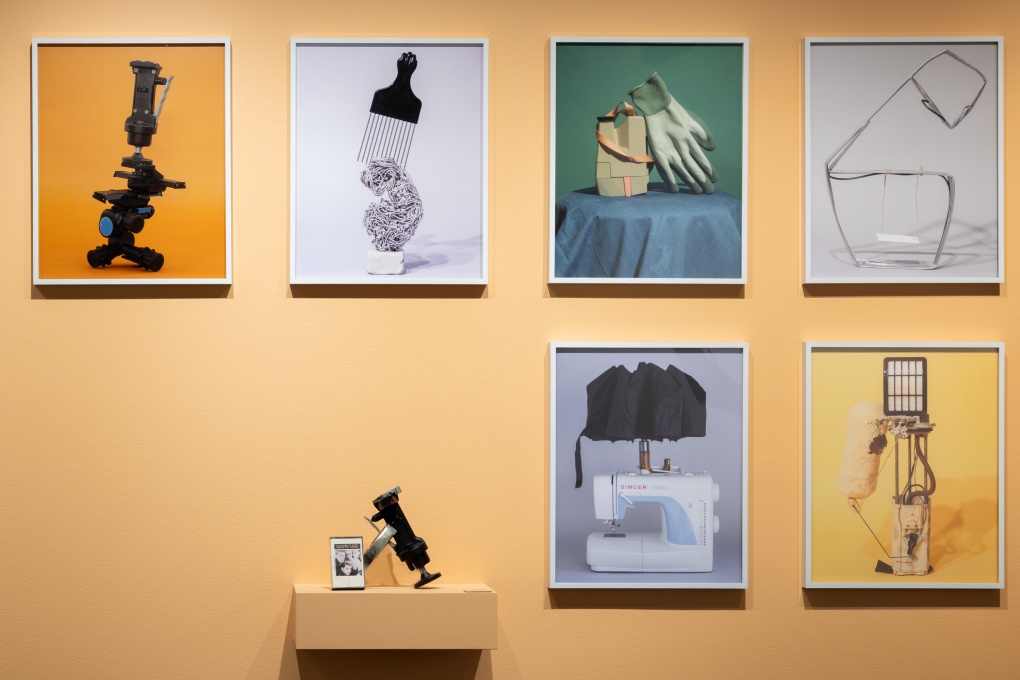
Installation view, Lenard Smith: Fortuitous Encounters, California Museum of Photography, 2026. Photo by Nikolay Maslov, courtesy of UCR ARTS.