Artists at Work: Scott Benzel
by Alex Heilbron
Scott Benzel makes sculpture, photography, performance, and new media that picks apart tangled chains of information and feeds pendants containing terabytes of references, one after the other, onto them. The work, which is visually compelling, withholds conceptually, asking the viewer to work alongside the artist, collecting, sorting, and laying out pieces that when arranged together creates a whole universe of horror and connected dots—it makes you believe. And then, the moment after you’ve almost put the key in the lock, all that accumulated information creates a whiplash that gives you amnesia. You are left feeling that you need to know more, must see more.
Scott has been a witness to L.A. culture, art and otherwise, for nearly 30 years and has helped a plethora of young artists take their first steps into the city’s international art community. And he shows up to everything, including your show at the tiny artist-run space that’s only been open for three months. I was first introduced to Scott through the Los Angeles Contemporary Archive (LACA) when I was a graduate student. He is kind and generous and would hate that I’m saying nice things about him. LACA has catalogued Scott’s work for many years, and it’s also where he keeps his studio in Chinatown. In the following conversation, we met at his studio to discuss online cults, the American military industrial complex, and how art responds to place.
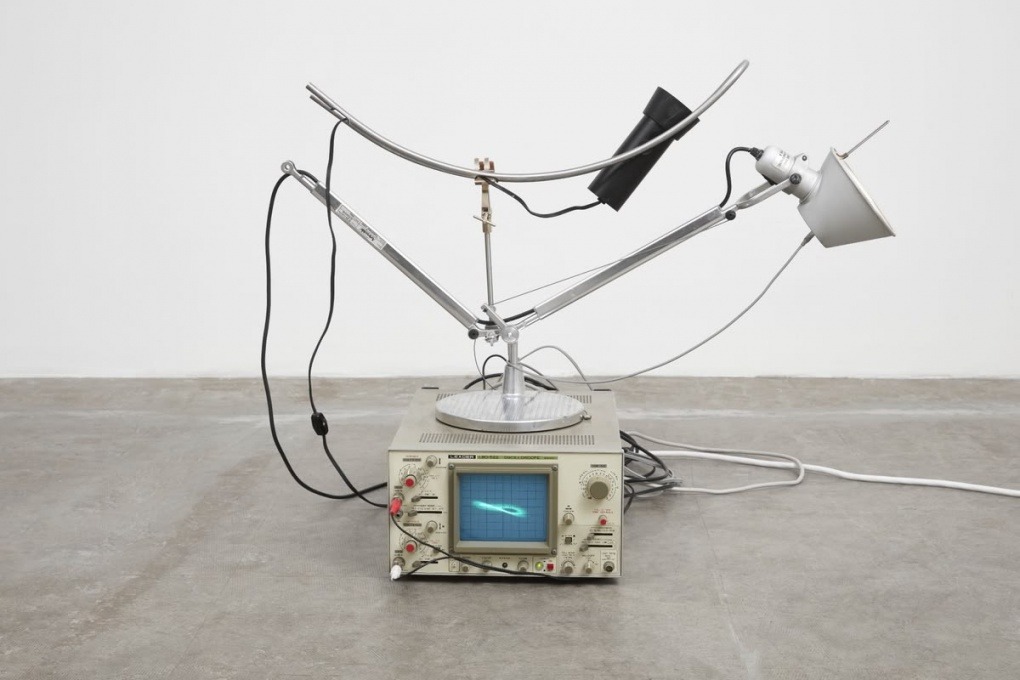
California Split / La Fourchette du Cavalier, 2020. Modified Artemide lamp, modified lamp by unknown Italian designer, oscilloscope, analog electronic circuits based on the equations of Hermann Minkowski and Edward Lorenz, modified ‘California Split’ film poster, Minkowski spacetime diagram, Poincaré diagrams from ‘New Methods of Celestial Mechanics,’ chicken wire, circuits by AST. Dimensions variable.
Alex Heilbron: Looking at your work, I feel as if I’m decoding layers of information. Could you describe for me how you embed information into your work?
Scott Benzel: It’s a slightly different process every time. Each of the works originates in research. Sometimes that research produces an object or an artifact of some sort and then, at other times, it’s a set of ideas. Depending on the process, I am led to either selecting an object, or selecting a theme, or an idea, or a concept. Sometimes there’s an element of recombination, or reframing, recontextualizing. At other times, there’s a process of finding an idea, and then finding a form with which to express that idea. It really depends on whether I’m starting with an individual object or artifact, or whether I’m starting with a suite of ideas.
AH: I’m curious about recombining. How do you and how are you recombining?

Hailey Strbry Glz Orgone Blaster (detail), 2025, plastic, resin, resin coloring, metal shavings, copper, quartz crystal. Photo by Josh Schaedel. Image courtesy of Phase Gallery.
SB: A good example is Hailey Strbry Glz Orgone Blaster (2025). I bought myself and my niece Erewhon smoothies and this cup sat around for a couple of years. In the meantime, I was thinking about Sherry Shriner, this online cult leader who lived in a double-wide in the middle of Ohio and had tens of thousands of followers who she had never met. Her followers would send her money and she would respond by sending what she called “orgone blasters.” She was working off of Wilhelm Reich’s idea of orgone energy. These orgone blasters would be made in cupcake trays and were combinations of polyester resin, metal shavings, quartz crystal, and copper. She developed a syncretic religion that involved 5G, but also aliens, and demons, and the aliens maybe were demons as well. These orgone blasters were designed to be thrown at cell phone towers, and later 5G towers. I was wanting to make orgone blasters and I saw the Erewhon cup and the combination of the two made sense to me. Erewhon, of course, is based on the book by Samuel Butler that has a long history in alternative health and wellness circles.1The store itself has this history as an alternative health/wellness place. I found the relationship between the Erewhon Hailey Bieber Strawberry Skin Glaze Smoothie and the Sherry Shriner orgone blaster to be productive and interesting.
AH: It feels like a relationship that you wouldn’t make right away, but as you’ve recombined, or brought these two things together, it makes sense, especially in this physical form. We’ve been talking about Sherry Shriner. Could you tell me a bit about how you came across her?
SB: I discovered her online and realized that she was working with orgonite. I did a deep dive at that point and I found one of her websites where she told people how to make orgone blasters. Part of her marketing involved dozens of websites that she constructed over years. You can find them on the Wayback Machine. They all had GIFs of reptilians, next to a flying saucer over the White House, next to a demon. Keeping in mind that some members of her cult, or her new religious movement, did horrible things and killed people thinking they were demons. Some committed suicide. There was a real dark side to this thing as well. I was mainly intrigued by her discovery of Wilhelm Reich’s ideas which float around in the art world. Joseph Beuys used a lot of Reich’s ideas.2Mike Kelley used a lot of Reich’s ideas.3To find this syncretic, online New Age Christian cult using these ideas was pretty interesting.
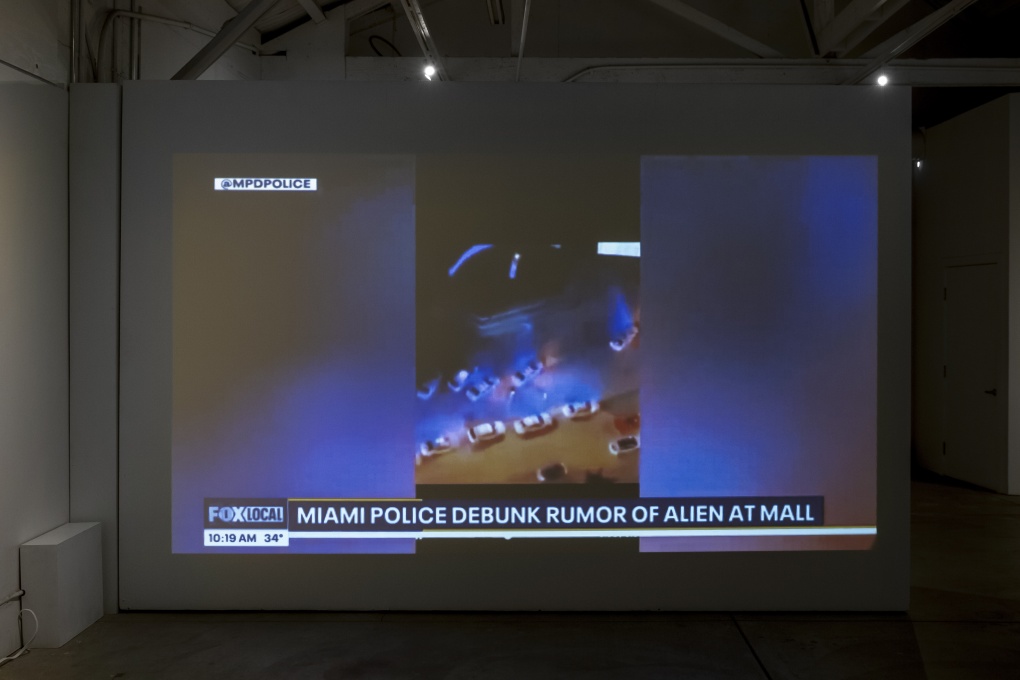
Mallrats, 2025. HD video. Image courtesy of Phase Gallery.
AH: Were you also finding information about her on message boards, or just directly through her website?
SB: There have been several television programs and there was a book written about her as well,4so her story is pretty well documented. I do think that the most interesting stuff I came across was either on her websites, or in some cases, embedded YouTube links within her websites. She started off on BlogTalkRadio, which was a radio station that could only be listened to online. It was a proto-podcast platform where people had time slots. Another interesting thing about her is that she was never photographed. There is one photograph of her in her late teens or early 20s that she would occasionally post.5There were no contemporary photographs of her, so no one really knew what she looked like. She was essentially a voice that carried across the internet, and people would respond to that voice.
AH: It makes me think she was a proto-AI, as a disembodied voice. I know you’re doing research into artificial intelligence… was that another reason why she was of interest to you?
SB: I think that the disembodied nature of her relationship with her followers, or fans, is pretty interesting. If you look at her websites you’ll see that she’s drawing from all of these different traditions, but it’s also very extreme. So she’s like a syncretic extremist. I do think that that black box quality that AI has is part of what drew me toward her. There are visuals but they’re memes, animated, gifs, and graphics. It’s a very different kind of aesthetic from how you interact with someone these days, with, say, Twitch or YouTube streamers.
AH: I’m fixating on her so much because I had never heard about her or her cult before seeing your show at Phase Gallery. You included the Erewhon piece we’ve been talking about. Could you talk more about that exhibition?
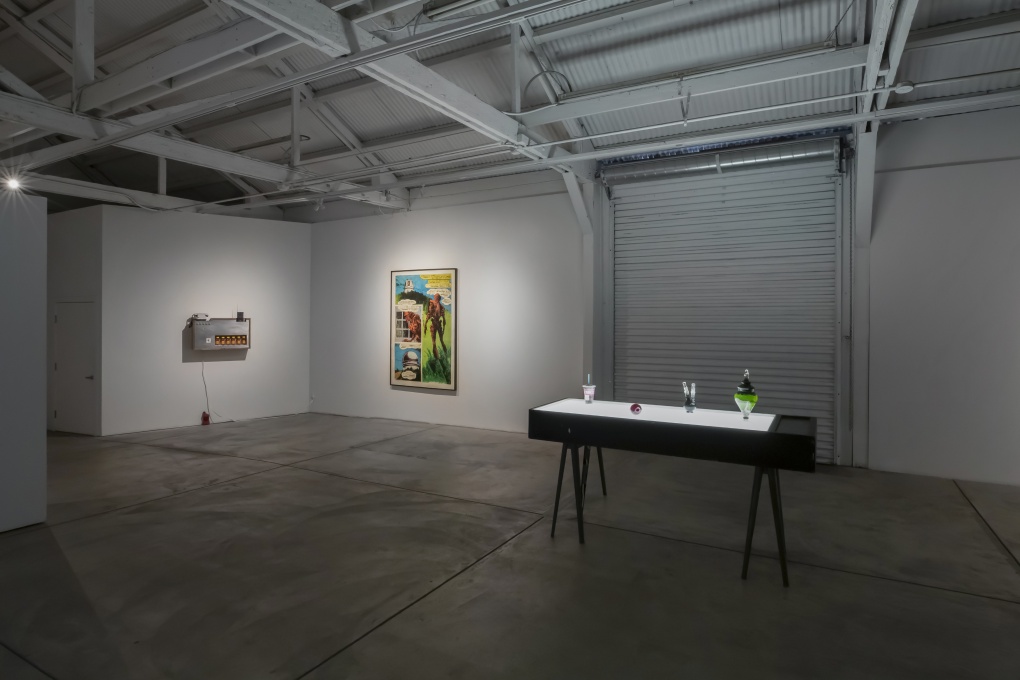
Installation view of psychomanteum, Phase Gallery, New York, October 10-November 25, 2025. Image courtesy of Phase Gallery.
SB: The Phase Gallery show was a departure. It was called psychomanteum, which is a quasi-neologism. It was coined in its modern incarnation by a parapsychologist who was using it to describe a darkened room where you would go in order to speak with spirits. The show included a number of wall assemblages that housed different artifacts that I put in conversation with one another. Often they included an electronic component. One of them has an oscilloscope on it that could be adjusted by these knobs on its face. Another has knobs that control a video synth, processing video of how to make orgone blasters using cupcake trays. There was an AI-driven piece [WIP Pythiai (2025)] that’s a work in progress. There’s been a trend recently of people making AI reconstructions of their loved ones who have passed away. I became fascinated, but also repulsed by it, and decided to explore it. The piece itself started out much more abstract and eventually got really concrete. It includes an image of my mom, a former girlfriend who passed away, and my friend Mike Kelley, who passed away. The image of Mike I took and the image of my mom I found—it was from the 1960s or early ‘70s. The image of Yvonne was a publicity photo. If you approach the piece, the statue stops rotating, one of the figures materializes and meets your gaze. We were working on developing some sort of speech interaction as well, and never really got that far. I think of it as a portrait of these people, but it’s a portrait that has a kind of uncanny lifelike-ness at certain times, and yet it’s not exactly lifelike, but it’s definitely more lifelike than, say, a still photograph.
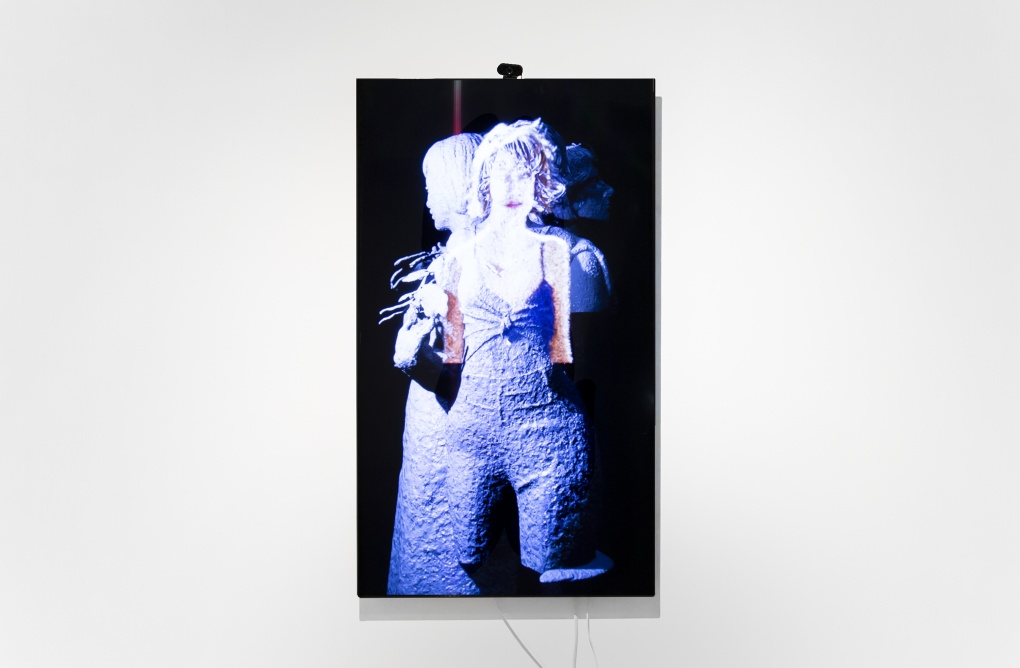
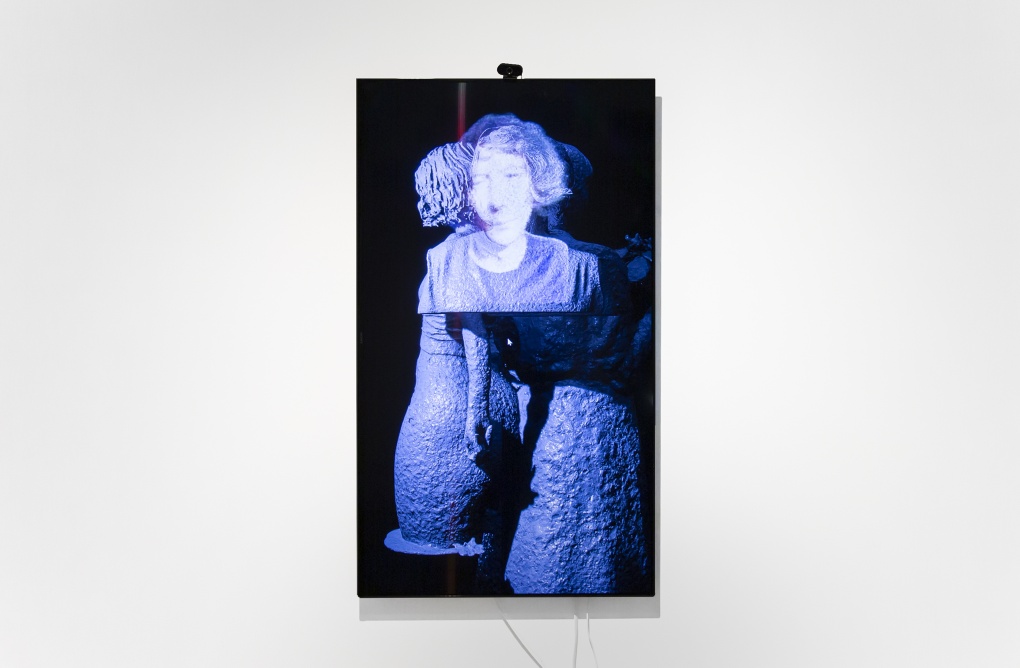
WIP Pythiai, 2025, interactive AI system (evolving), flatscreen. Image courtesy of Phase Gallery.
AH: When I look at your work I’m struck by how long it took you to do all of this research, to put all of these things together. And you’re often communicating without necessarily using direct language, it’s not always didactic.
SB: The show at Phase came together really quickly. We started in May and it opened in early October. Usually the ideas for the works are floating around for a while before I start to materialize them. I do actually think of some of the work as didactic. Some of it is very straightforward, but often the work hints or feints at these different complexes of ideas. It’s a pretty twisted process and it evolves. The initial idea often is something simple and then it’ll complexify, for lack of a better word. It’ll get more knotted. There is a degree of abstraction. There’s a push-pull between the indexical, or the real, or the didactic, and then these processes of abstraction. The processes of abstraction are mostly to do with this idea of either recombination or pointing at something in a way that’s not entirely straightforward.
AH: The pointing that you’re doing, I visualize it like a shooting star. There’s the head of the star and then there’s this detritus which is scattered from forward momentum. In another sense, there are layers of information that I’m decoding when I look at your work. How do your ideas become more complex?
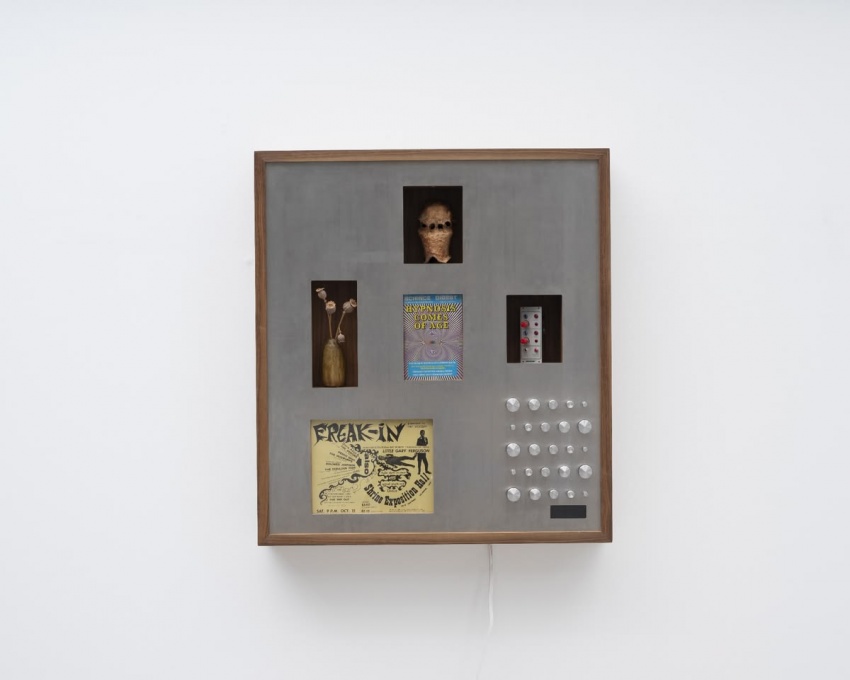
Psychomanteum (Freak-in), 2025, aluminum, wood, glass, hive, ceramic vase, dried poppies, AST Demon Brothers custom eurorack module, Science Digest April 1971, Freak-in 1966 concert flyer, electronics, LEDs, flatscreen. Image courtesy of Phase Gallery.
SB: For psychomanteum we CNCed [computer numerical control] aluminum faces for these wood cabinets. They are clunky and I liked that in the original CNC drawings. But sometimes I look at them and I think they are too clunky, too ugly. Other times I think this is exactly what it should be, it should be clunky. The formal decisions are where the ideas get mashed or gnashed together. In some cases the formal decisions are straightforward. Sometimes I’ll start by creating a grammar out of several objects. Often that looks too easy to me so I’ll introduce something that complicates the grammar, or ties it up in a way. With each of the pieces in pychomanteum there is a collection of objects that emanate from different subcultural spheres. Then it’s the interaction between those things that either communicates, or in some cases doesn’t communicate, or complicates, the communication of the piece. I would say that’s the poetics of it. If there’s a didactic element, there’s also a poetics to each of these that involves the friction or the rubbing up of different orders of objects against one another. That’s something that I’m trying to do consistently.
AH: Is that where the abstraction is happening, in that final scene of viewing?
SB: There are connections between these images or objects, I don’t want to say that they’re arbitrary, necessarily, but they border on being highly subjective. I started a Substack in which I go back and try to make sense of some of these connections that are hard to make sense of. So, I think of it as a clarifying process.
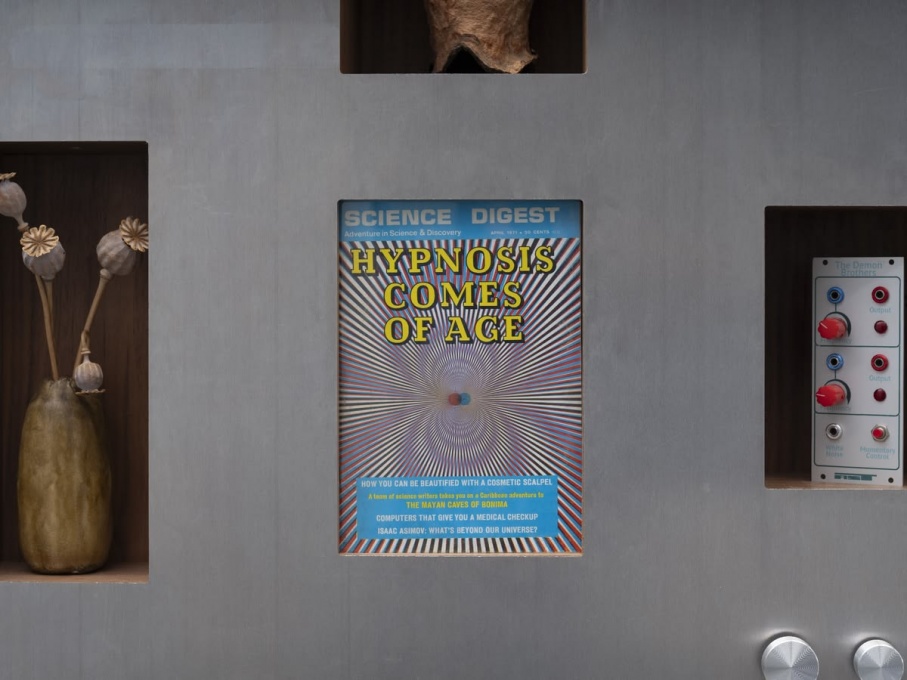
Psychomanteum (Freak-in), 2025, aluminum, wood, glass, hive, ceramic vase, dried poppies, AST Demon Brothers custom eurorack module, Science Digest April 1971, Freak-in 1966 concert flyer, electronics, LEDs, flatscreen. Image courtesy of Phase Gallery.
AH: I actually read a lot of your Substack in preparation for this. It’s the reason why I brought up the relationship between AI and Sherry Shriner, because you wrote about artificial intelligence and the occult. Do you want to talk about that?
SB: When I talk about modernist cryptopoetics, I’m talking about the history of people like W.B. Yeats using seances and trance mediums and then also doing automatic writing along with his wife Georgie in order to come up with the epic poem, A Vision, but also to come up with The Second Coming. H.D., or Hilda Doolittle, used similar methods like automatic writing and trance-channeling. Sylvia Plath and Ted Hughes used the Ouija board to channel several of her major works. Poet James Merrill almost exclusively used the Ouija board to create his major poems. On the other more visual side of the equation, there is spirit photography, or on the sonic end of it, Konstantin Raudive, who recorded voices from the radio ether but considered them spirit voices. All of these things have a relationship to AI and specifically to the black box elements of LLMs [large language models] and other types of generative AI where we really don’t know how certain decisions are being made, how certain images or sentences or whatever are being strung together. We can have a conceptual understanding of how it works, certainly an engineer or mathematician can dig into the algorithm and tell you exactly how this thing is working, and yet there’s still this black box quality. I like that element of something coming out of the ether. It’s probably my favorite thing about it. I don’t like a lot of the more rational applications of AI. I like the hallucinatory or poetic applications of it.
I did a performance at Blum and Poe [in 2023] with Alan Tofighi, who works with me a lot, and Kathi Schultz. We were interested in channeling and its relationship to AI. We also looked at the vocoder which was invented for bandwidth conservation many years before it began being used in music. It crosses the formants of a voice with an electronic instrument. You hear this in Kraftwerk, you hear this in early hip-hop as well. It’s almost a form of dehumanization, or mechanization of the human voice. In that case, it’s a conscious kind of hybrid, whereas with AI and generative AI in particular, there’s a quality of, yes, you can guide it through prompts, yes, you can guide it through a greater understanding of the model or of the algorithm, but at the same time, there’s something chaotic in there. There’s something that’s out of control in there, certainly out of human understanding or guidance, that I thought was interesting. All of these kinds of registers play into the work.
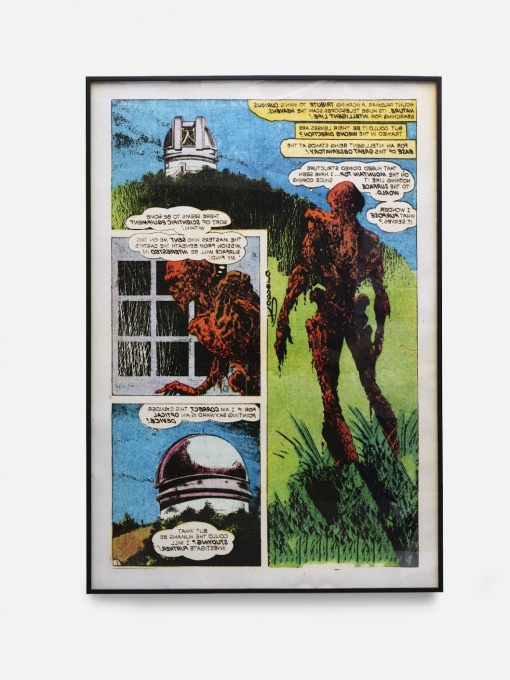
Palomar (Bog Beast), 2025, c-print in artist’s frame, 49 x 70 in. Image courtesy of Phase Gallery.
AH: You’re interested in this cutting-edge technology, artificial intelligence, which is being worked on in Silicon Valley. New Age religion has historically been located in California. Do you feel like you poke around at your work’s relationship to California?
SB: Place matters in the work and I do think of myself as an L.A. artist in the same way Allen Ruppersberg is an L.A. artist, or Ed Ruscha is an L.A. artist, or Betye Saar is a L.A. artist. Place has a strong importance. I used to do more work that was not exactly site-specific but was reliant on site for a lot of the meaning. This was true of some of the sound work I used to do where I would make the piece to suit a given space. The high watermark of that was at Mount Wilson Observatory where I made the piece very specifically for that space.
All of the large AI companies, or at least the US-based ones, are based here. A lot of Silicon Valley engineers were really into the hippie psychedelic scene and also the New Age or human ecology elements of somewhere like Esalen. I do think that there’s a strong linkage between the rise of New Age culture in California and the rise of Silicon Valley. In some ways that is a myth because there was an equal amount of military-industrial input into Silicon Valley from the beginning of contemporary computation. Colonel John Alexander, this figure that was portrayed in Men Who Stare at Goats (2009), was trying to reform the army and create less lethal weapons and was involved in the Stargate program at the Stanford Research Institute. He was also very heavily involved in psychological operations. In some ways the military had a New Age component within it as well. These things are not necessarily completely separate from one another.
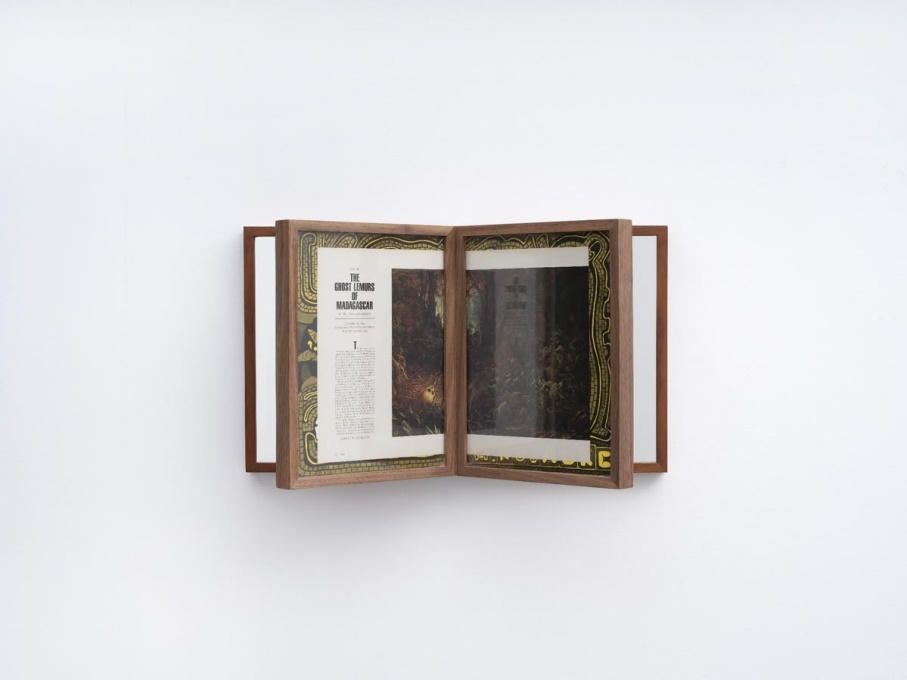
Go Faster!, wood, glass, Le Minotaure, no. 12-13, Paris, 1939; Omni Science Fiction no. 103, April 1987; Rat Fink Comix no. 6, 1992. Image courtesy of Phase Gallery.
AH: Not much that is generative comes from the military, it’s total death. Whereas when you have something like New Age religion and psychedelics, that also feels like a generative death. I’m not sure how to define Silicon Valley, which to me is the American symbolic center of artificial intelligence. All three are intertwined in the contemporary history of the state.
SB: In the ‘90s there was a lot of crossover, particularly in the Bay Area, between counterculture, which encompassed both the New Age and the psychedelic, as well as punk and post-punk countercultures. I had friends that were involved in this, and I was around it, through magazines like Boing Boing, Mondo 2000, and the early Wired. There’s the famous story of Steve Jobs dropping acid at Reed, taking a calligraphy class, and that’s the origin story of the font system on the Mac. Then you have him going to these military research labs and seeing the mouse for the first time, or seeing the smaller personal computer. Also seeing the first desktop. All of this took place at Xerox PARC which was private-public military-funded research.
AH: That crossover is still happening, we’re often down stream from military innovations. In the past 10 years screens have become ubiquitous in our day-to-day lives. Do you think your work has changed with that ubiquity?
SB: I was talking about it in class the other day. Sometimes I’ll find myself on my couch and I’ll have my phone, iPad, television on, two laptops running and sometimes a projector running. That’s truly a bizarre number of screens operating at the same time. It’s not really intentional, I’m just shuttling back and forth between them. I’ve been making a lot more screen-based work and more video in general. There was a CRT monitor in the Maldistribution show at Human Resources; I don’t think there were any monitors in a couple of my other shows. Those shows were much more about the object. And by “object” I mean something that just sits there and doesn’t really do anything, but has all of these qualities and narratives embedded in them.
AH: On these screens, what are the different activities that are you partaking in?
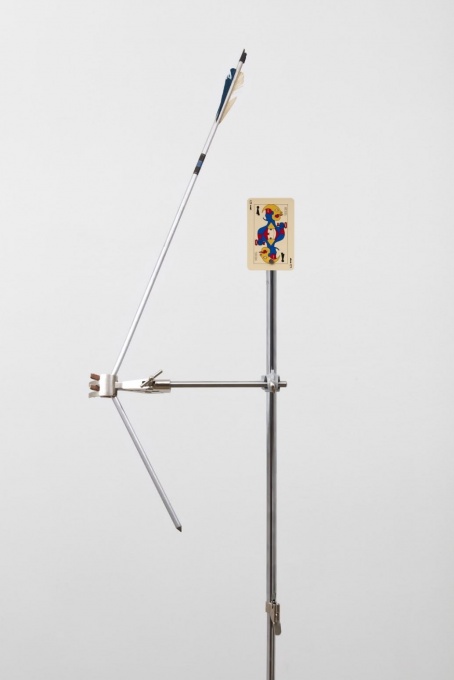
Scott Benzel, Telepathic Gambler, 2020. Surrealist playing cards, Zenith/Rhine ESP test cards, broken aluminum arrow, Mars meteorite dust, Cal-Neva Lodge dice, iPod Touch, stroboscope, hardware, modified nickel steel music stands. Dimensions variable. Image courtesy of Bel Ami.
SB: Usually on the laptops it’s writing, reading, or working on some ideas on a Keynote. iPad really varies. Phone, the usual stuff. Then usually some televisual thing is on in the background. Usually it’s YouTube or Twitch or some sort of other streaming service. So you’re mainly on the internet as you’re doing all of this stuff but on all these different devices of different sizes and configurations.
AH: I can relate, I go to bed at night watching something on my laptop and usually will have my phone in my hand doing something else at the same time. I’m really curious what you think about the terms “screened reality” versus “being online.” I’ve never really quite been able to define for myself what the difference is.
SB: It’s pretty smooth. Some of the research feels a lot more online, especially when I’m trying to track down a PDF, or an essay, websites, Substacks, or whatever. That is digging, it’s more engaged. Whereas with a lot of screen-based stuff, I’m just kind of checking out and consuming it. I was talking to somebody the other day about One Battle After Another, the Paul Thomas Anderson movie based loosely on Thomas Pynchon’s Vineland. We agreed that the thing we missed most in the film were these creatures that sort of just constantly consume TV. They’re called Thanatoids and are vaguely living beings, or living dead, that haunt the places where past events occurred. In Vineland, the Thanatoids are TV addicts, so they constantly get their brains reconfigured through passive consumption. They’re the ultimate burners, and the word is funny, because it basically means deadoids, or deathoids. That was my most missed thing in Vineland that didn’t make it into the movie.
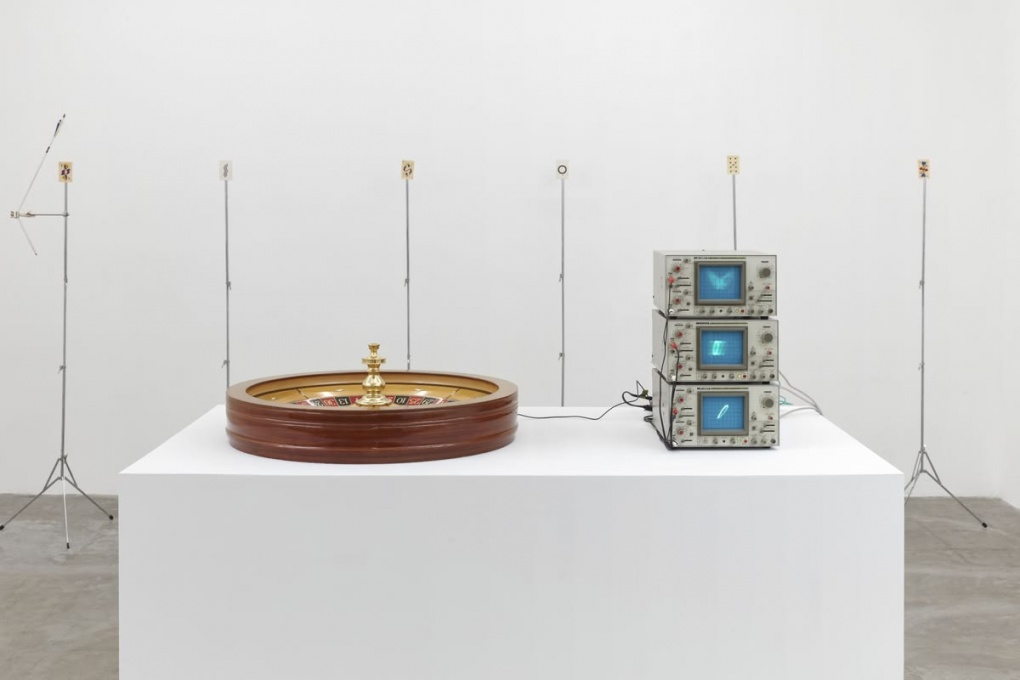
Scott Benzel, Hybrid Monte Carlo, 2020. Regulation roulette wheel, regulation ‘pin,’ contact mic, motion detector, oscilloscopes, analog electronic circuits based on the equations of Henri Poincaré and Edward Lorenz (top: Lorenz ‘Owl Face,’ middle: Poincaré diagram, bottom: Poincaré-derived RC ‘chaos ladder’), circuits by AST. 73 x 20 x 41 in (185.4 x 50.8 x 104.1 cm). Image courtesy of Bel Ami.
AH: When you talk about that, it reminded me of the title of the show that you had in 2021, Mindless Pleasures. Could you talk a bit more about that title?
SB: Mindless Pleasures was the working title for Thomas Pynchon’s Gravity’s Rainbow. It was the working title right up to the last minute and then somehow it got changed. There’s an illustration of the original cover floating around online, which is of The Tower card from the tarot. The tower is being zapped by lightning and someone is hurling out of the tower and in the Pynchon version it’s a guy in bell bottoms.6
It’s a hippie being blasted out of this tower. A lot of the content of that show had to do with chaos theory or complexity theory. But it’s also tied up in World War II and the creation of the atom bomb—the Manhattan Project. I think in similar ways to the book Gravity’s Rainbow, Mindless Pleasures, the show, kind of circles around these ideas. Some of the ideas are less intense, a bit more lighthearted, while others are dead serious and have to do with the creation of this technique of mass destruction. A few people could wipe out the Earth using this technology. I think it’s chilling, disturbing, and also fascinating that these people decided to create this thing.
AH: There were a lot of visual references to gambling in that exhibition.
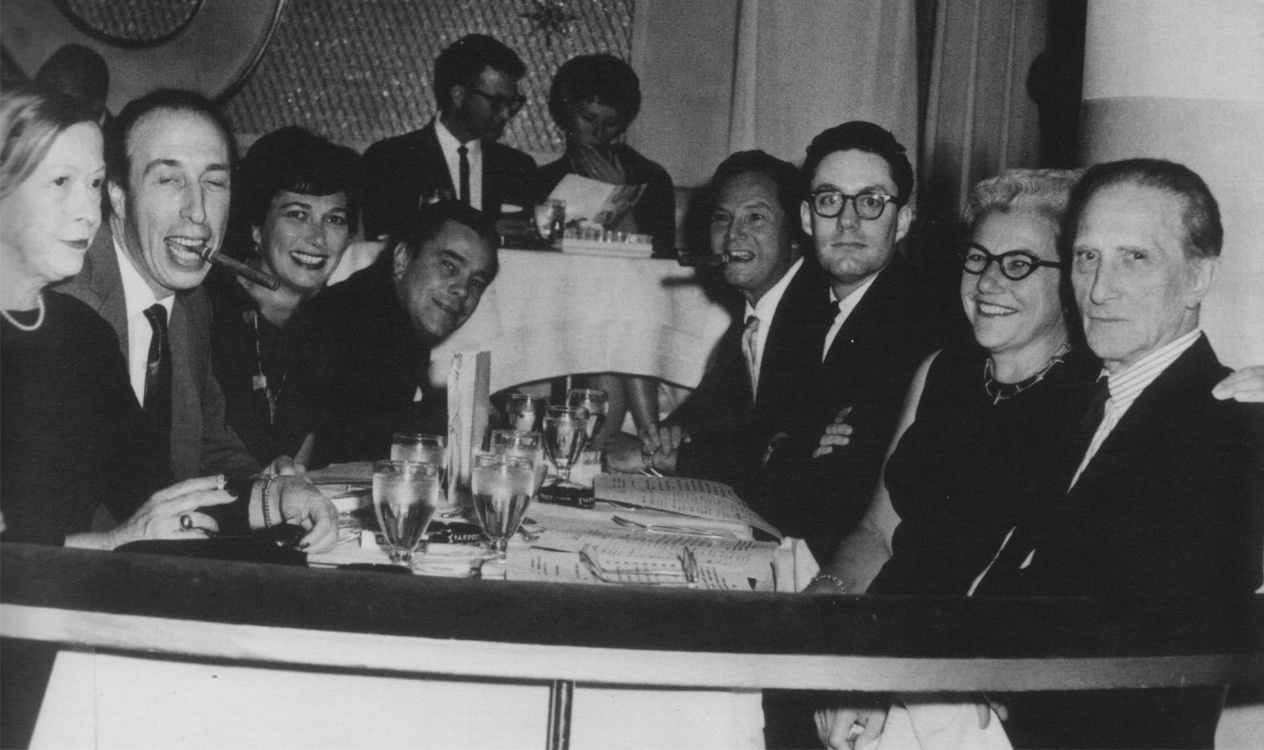
Stardust Hotel, Las Vegas, 1963. Seated from left to right are Teeny Duchamp, Richard Hamilton, Betty Factor, William Copley, Monte Factor, Walter Hopps, Betty Asher, and Marcel Duchamp. Image via East of Borneo.
SB: I grew up in Las Vegas. Vegas has been a touchstone for me forever. I learned that Stanisław Ulam and John von Neumann used a simulated roulette wheel to come up with random numbers for the particle interactions when nuclear fission started. I was also interested in Marcel Duchamp’s one trip to Las Vegas with Betty Asher, who was a local gallerist in L.A., and the mother of Michael Asher, who was one of my teachers at CalArts. Duchamp was here working on his first museum retrospective at the Pasadena Art Museum. They kidnapped him and took him to Las Vegas and brought him to the Stardust because they thought that he would like to see the Lido de Paris. There’s this photograph of him, taken by one of the women who used to walk around with a camera photographing everybody. So this photograph of him, Betty Asher, a bunch of other L.A. art world people staring into the lens of this showgirl/photographer. In Vegas he was giving tips to Walter Hopps, who was the director of the Pasadena Art Museum at that time. So those two stories: von Neumann and Ulam using the random numbers generated by this roulette simulator, and Duchamp in Vegas giving Walter Hopps tips on roulette, is where the show came from.
AH: It’s almost as if you’re weaving your personal history along with cultural history.
SB: The Stardust existed while I was growing up. I wasn’t alive when Duchamp would have been there, but the Stardust was still there, and it probably looked the same. These little threads of continuity are interesting.
AH: What are you obsessing over right now?
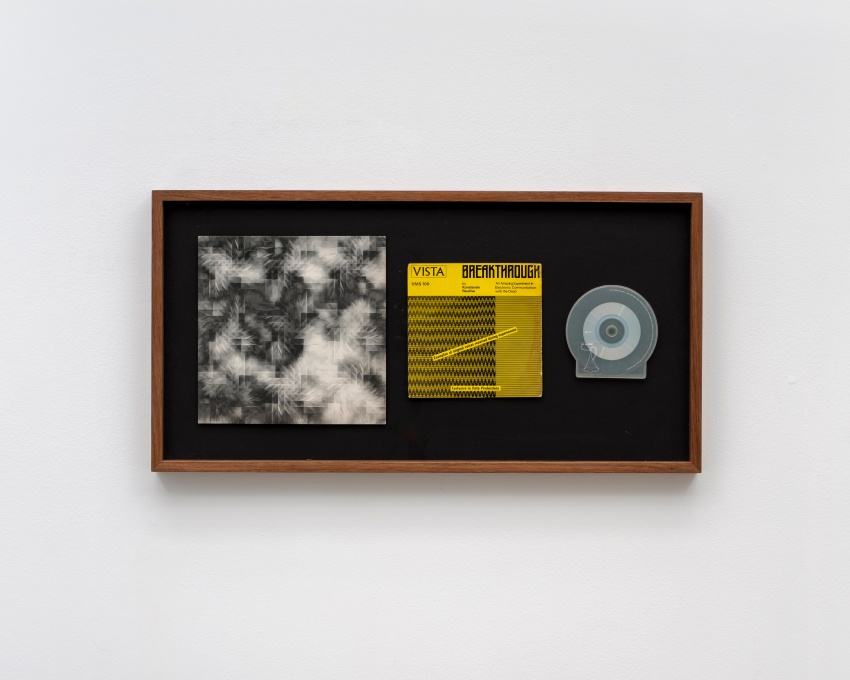
Breakthrough/ELpH, 2025, ElpH, pHILM, 10” EP, Eskaton, 1994; Konstantin Raudive, Breakthrough, 7”, Vista, 1971; ELpH, Zwölf, Minimax CD, Raster-Noton, 1999. Image courtesy of Phase Gallery.
SB: My project “Outer Gateways” at Kaje in Brooklyn centered on Konstantins Raudive, the spirit voices guy who was Latvian but lived much of his life in Sweden. I made a sound work consisting of a history of recordings of both mediums that are channeling spirits and singing or speaking in tongues, as well as a lot of radio recordings. I also worked with these small electronic devices called Raudive diodes that pick up a wide spectrum of radio waves. I combined this all into a longish sound work.
I’m also in the process of formulating a show about the more didactic and pedagogical elements of my practice. There’s a spectrum to my work. Some of it is on the poetic side of things, and some is much more on the didactic side of things. It would include the more didactic works combined with some lectures that I consider to be art-like, if not art themselves. These would be derived from my actual pedagogy, so my actual teaching at CalArts. They are based on some sort of attempt to simultaneously convey verifiable information, but do it in a way that is interesting and somewhat art-like, in the same way that the more didactic works convey a certain amount of information. They also have, for lack of a better word, a poetics to them.
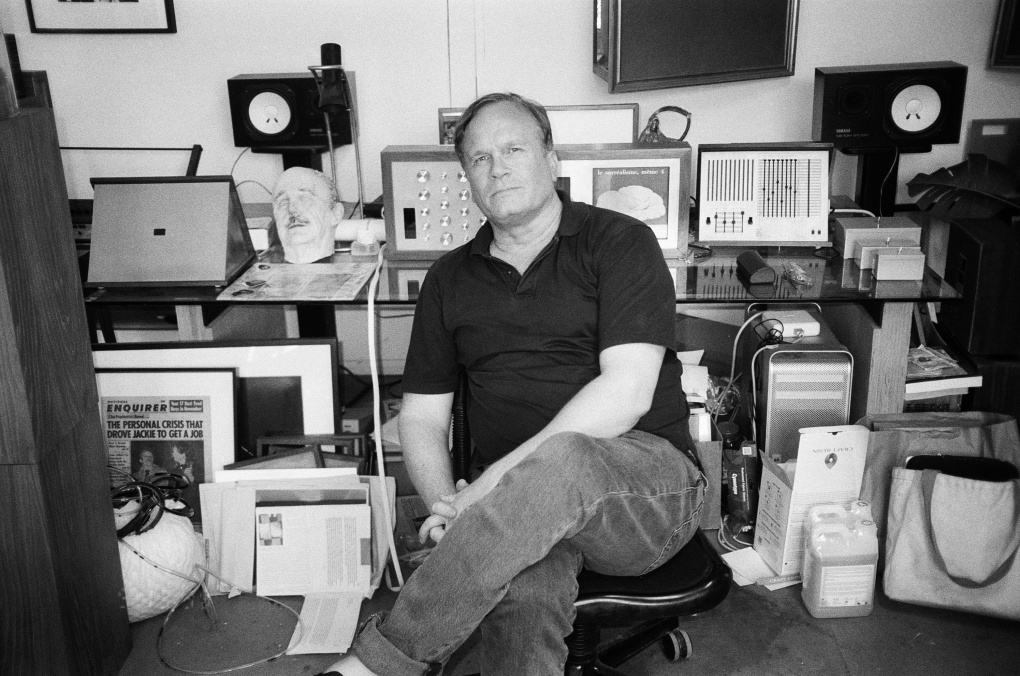
Portrait of the artist. Photograph by Colette Zighelboim.