Julian’s Angels: Moments in L.A., 1960-1982
by Anthony Strain
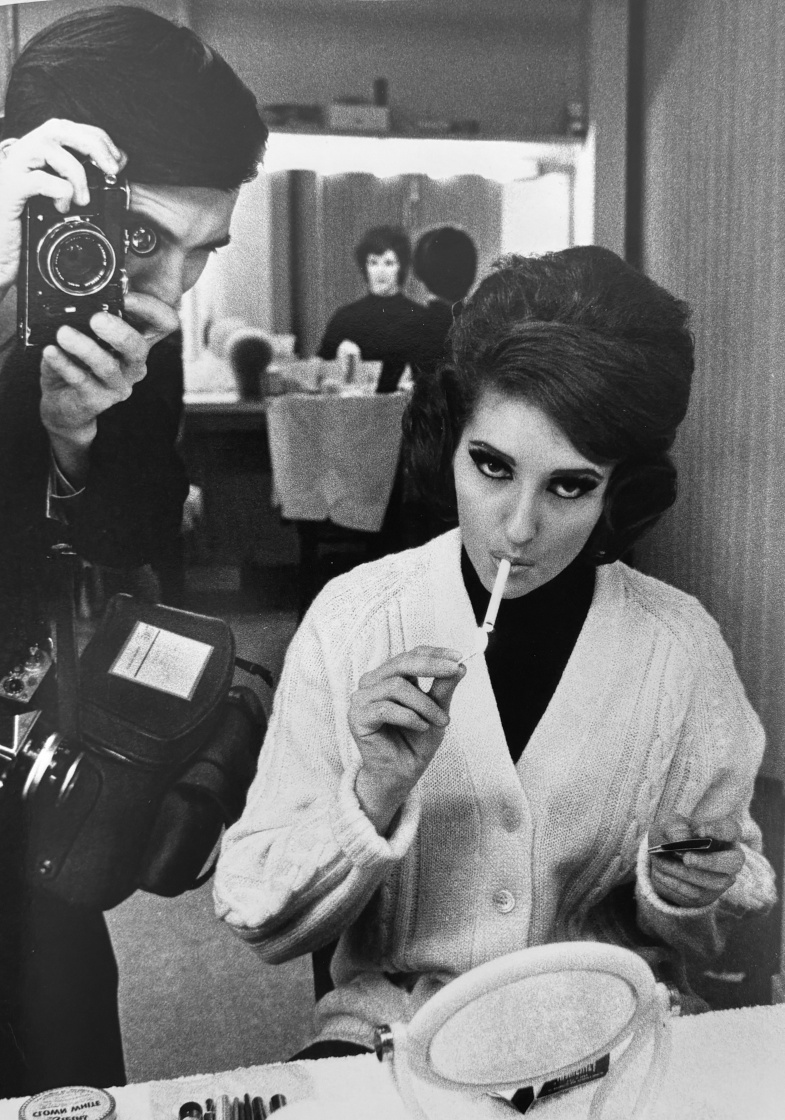
Julian Wasser, Backstage Selfie, c. 1965. Vintage gelatin silver print. 9.5 inches x 7 inches. © The Estate of Julian Wasser, Courtesy of Craig Krull Gallery, Santa Monica, CA.
Julian Wasser is not capital-letter famous, yet it’s hard to imagine Los Angeles as the glittering capital of the 1960s without his images. His technique, all high contrasts and chrome flashes, grew out of D.C. newsrooms and his early exploits stealing his dad’s car and browsing police scanners. His only monograph is called The Way We Were, which sounds like a placeholder title, a forgettable way to remember something, yet it remains Wasser’s resolute liturgy and legacy. Inside there are photographs of Conrad Hilton, David Bowie, the Jackson 5, Jayne Mansfield, Martin Luther King, Clint Eastwood, and Alfred Hitchcock; Barbra Streisand in the iconically sheer Arnold Scaasi pantsuit, at the 1968 Oscars1; 14-year-old Jodie Foster reading an issue of L’uomo Vogue with Robert De Niro on the cover. He photographed beehive hairdos and the Beach Boys2, the police and the Rolling Stones, James Brown and a Cadillac on a tarmac at LAX. He photographed teens smoking for LIFE, women’s butts for Escapade, Wilshire Boulevard traffic for Los Angeles, and lines around the block to get into the clubs that sprouted all across Sunset Strip: Pandora’s Box, Sea Witch3, the Romanoff, the Daisy, the Whisky.4
Wasser’s is a street photographer’s story. Influenced by the tabloid maestro Arthur Fellig, aka Weegee, and the postwar wire service style, he took pictures of anyone doing anything in public in their daily lives—first with a Contax 35mm, later a 4×5 Speed Graphic, and finally with a Nikon in Los Angeles, where a lot of the people walking around happened to be famous, or in some cases, almost. Imagine access to celebrity without bureaucracy, fame without accountability, the freedom to walk up to that actress and take her picture without red tape. “The glamour of Old Hollywood was still intact,” Wasser wrote,5“but at the same time, everyone was approachable.”
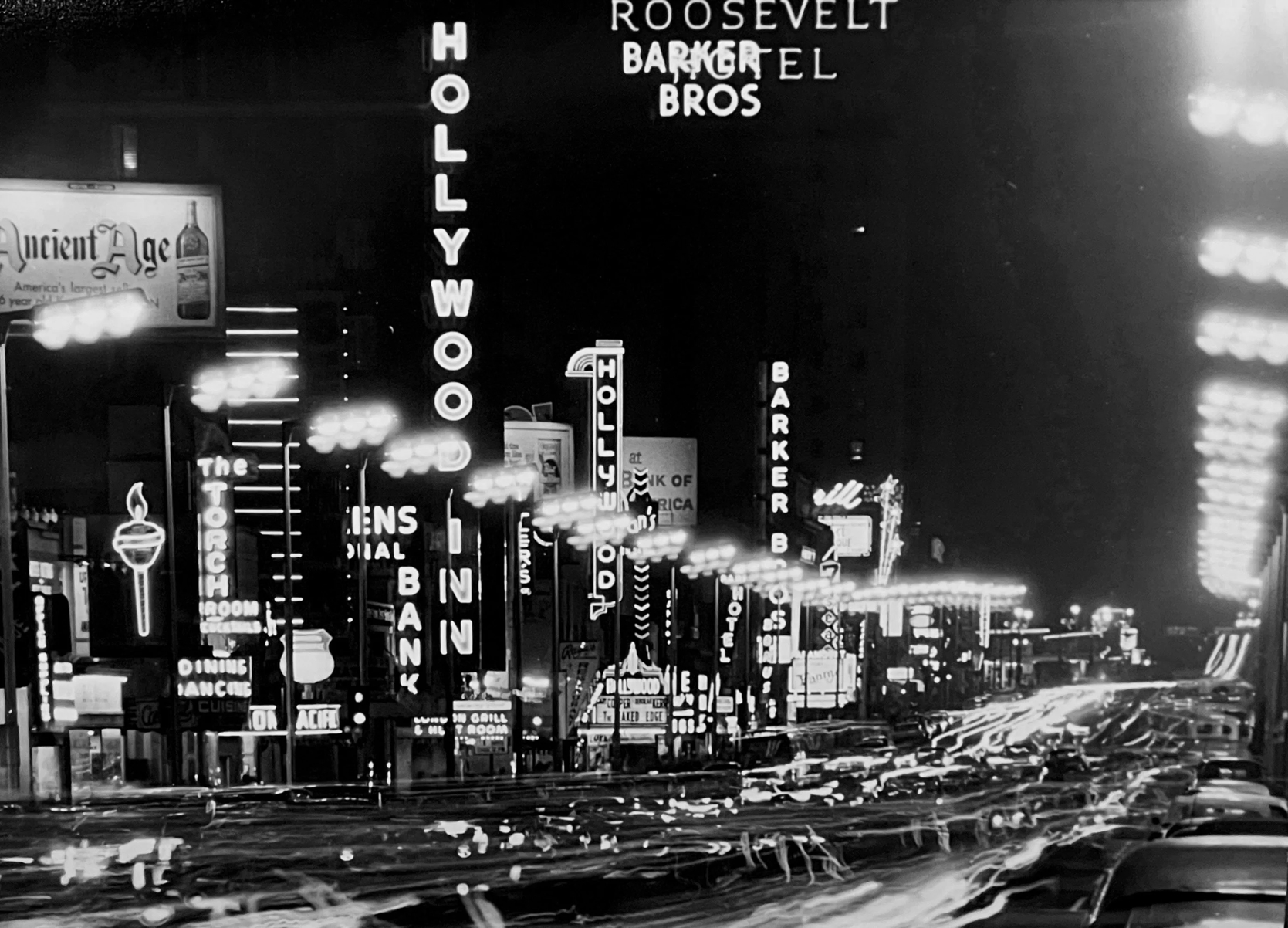
Julian Wasser, Hollywood Blvd at Night, 1961. Vintage silver gelatin print. 7 1/8 inches x 9 7/8 inches. © The Estate of Julian Wasser, Courtesy of Craig Krull Gallery, Santa Monica, CA.
JFK Ascendant: 1960
Ahead of the Democratic convention in Los Angeles, Senator John F. Kennedy’s helicopter landed right at the first tee of the L.A. Country Club, scattering Republicans straight from the buffet. He stayed at the Beverly Hilton instead of the Biltmore, where the convention was, because the Beverly Hilton was where the stars stayed and the Biltmore was where the Democrats stayed. Accented and sailboated, Kennedy was East Coast to the bone, but that image of charisma and vitality made Los Angeles the perfect coronation site, especially since it was mostly fake: his healthy “tan” was his Addison’s disease glowing, otherworldly, and his health was FDR-level before he ever took the oath, his back damaged during the War in the Pacific.6Norman Mailer compared him to Marlon Brando: “… Kennedy’s most characteristic quality is the remote and private air of a man who has traversed some lonely terrain of experience, of loss and gain, of nearness to death.”7Wasser photographed Jack the night in July when he accepted the nomination, introducing the New Frontier from his pulpit at the Coliseum, where just a year earlier the Dodgers had won their first World Series since moving from Brooklyn.8Despite the lowness of the angle the senator appears trapped in a beam of light, the bunting on the dais resembling a pack of cigarettes. He does not wear sunglasses, although it’s easy to draw them on his face from memory. Dodger Stadium opened in 1962. The renaissance of L.A. was underway.
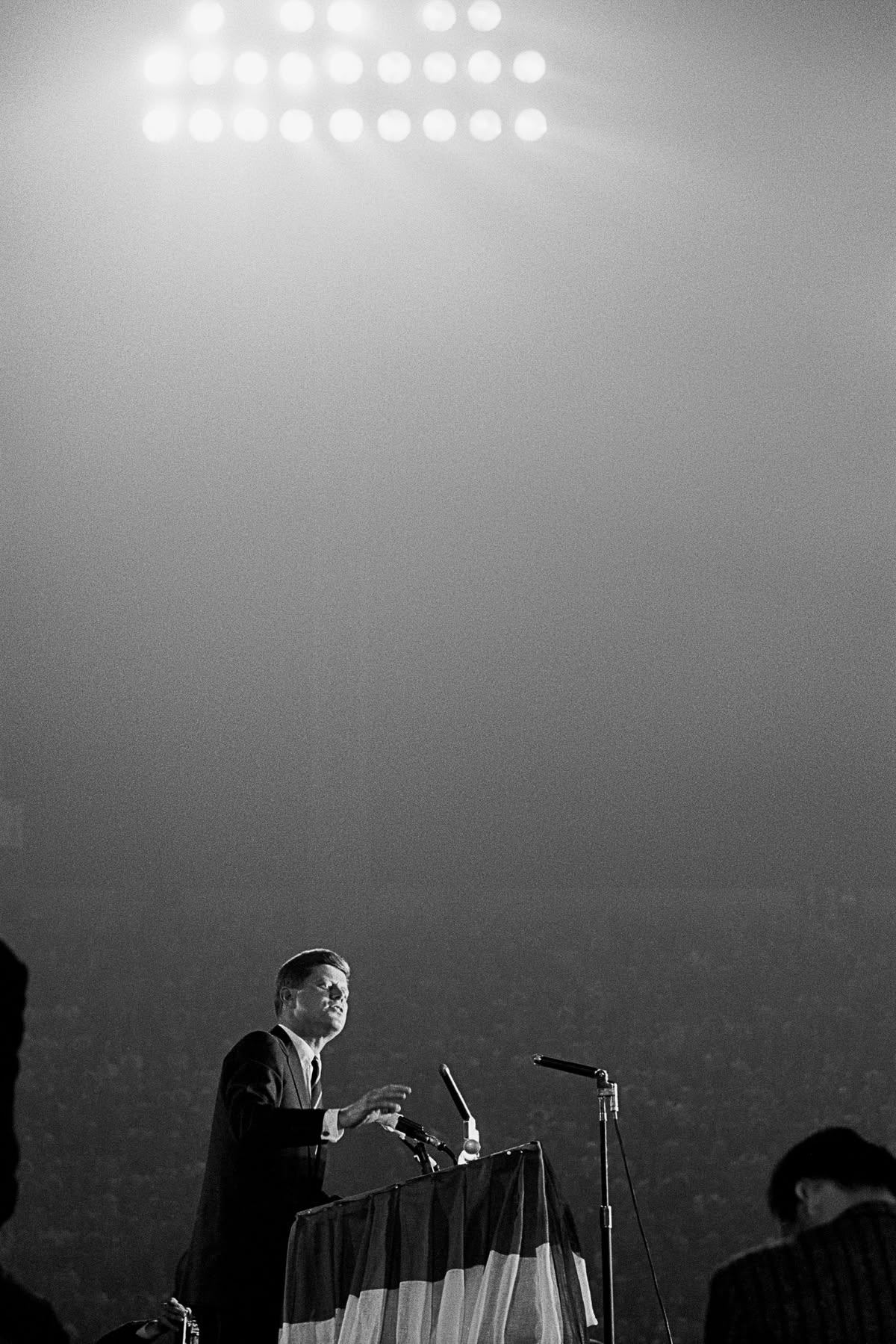
John F. Kennedy, New Frontier Speech, Los Angeles Memorial Coliseum, 1960. Photo © Julian Wasser. Courtesy of The Estate of Julian Wasser.
Warhol’s California: 1962-1963
Another giant from the East, another not easily associated with Los Angeles, then or now, was Andy Warhol, whose silk screened soup cans threatened to fence Andy into pop art quarantine. Ferus Gallery, which opened on La Cienega Boulevard in 1957,9provided the soft push, or soft landing, Warhol’s fine art career needed: his first solo show in the United States.10 Irving Blum, chief benefactor of Ferus from 1958 until its closure in 1966,11believed the soup cans would resonate in the California light, as vivid as avocado trees. Warhol was attracted immediately, especially when Blum exaggerated the number of movie stars who came through the space (zero).12Instead of hanging the prints, Blum shelved them, like so many shoppables, anticipating a sellout, which it was, albeit in the wrong way. The show bombed with critics and collectors, and Blum bought all the work himself on layaway.13
Before and after Warhol, Ferus was the nerve center for the new California art, with its macho sensation and splashy sense of humor. There was a brief window around the turn of the 1960s when the Ferus orbit of artists—notably Ed Ruscha, Robert Irwin, Ken Price, John Altoon, and Billy Al Bengston—turned West Hollywood into a memorable parade of alpha horseplay, all motorcycles and surfboards. To service them, Ferus built a colorful roster of L.A. luminaries, like Dennis Janss Jr., who founded the suburb Thousand Oaks; Blum’s uncle, the diamond-setter Albert Waldinger; Don Factor, heir to the Max Factor cosmetics fortune, and Frederick Weisman, Hunt Foods exec and brother-in-law to Norton Simon. Dennis Hopper, another early investor in the scene,14secured Warhol a suite at the Beverly Hills Hotel for his triumphant return to Ferus, in September 1963, for a sophomore show of 23 seven-foot-tall Elvis silkscreens. This time, they sold out for real. A month later, as Ferus apexed, Hopps brought Marcel Duchamp, who had lived in New York since the war, to the Pasadena Art Museum for his first career retrospective. Lurking like a wasp around all this activity was Wasser, who went to the Duchamp opening on assignment for Time and snapped Hopper posing with his wife Brooke Hayward, with the actor Taylor Mead, and with Warhol and Bengston—Bengston pulling Warhol’s still-cherubic face up into a smile’s V, and Hopper cutting a tuxedoed figure that drastically predates his ragged counterculture fame.
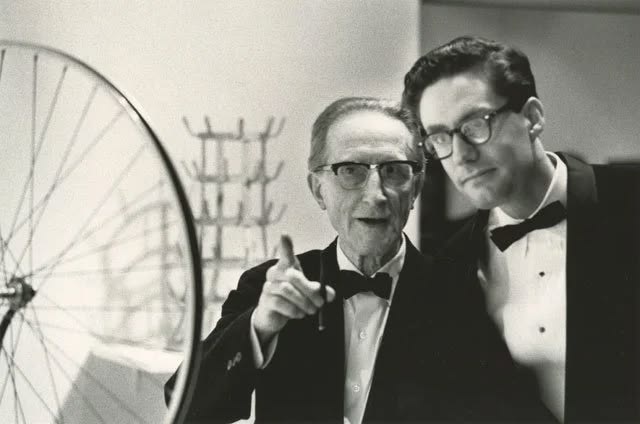
Marcel Duchamp and Walter Hopps at the Opening Reception, Duchamp Retrospective, Pasadena Art Museum, 1963. Photo by Julian Wasser. © the Estate of Julian Wasser, Courtesy Craig Krull Gallery, Santa Monica, CA.
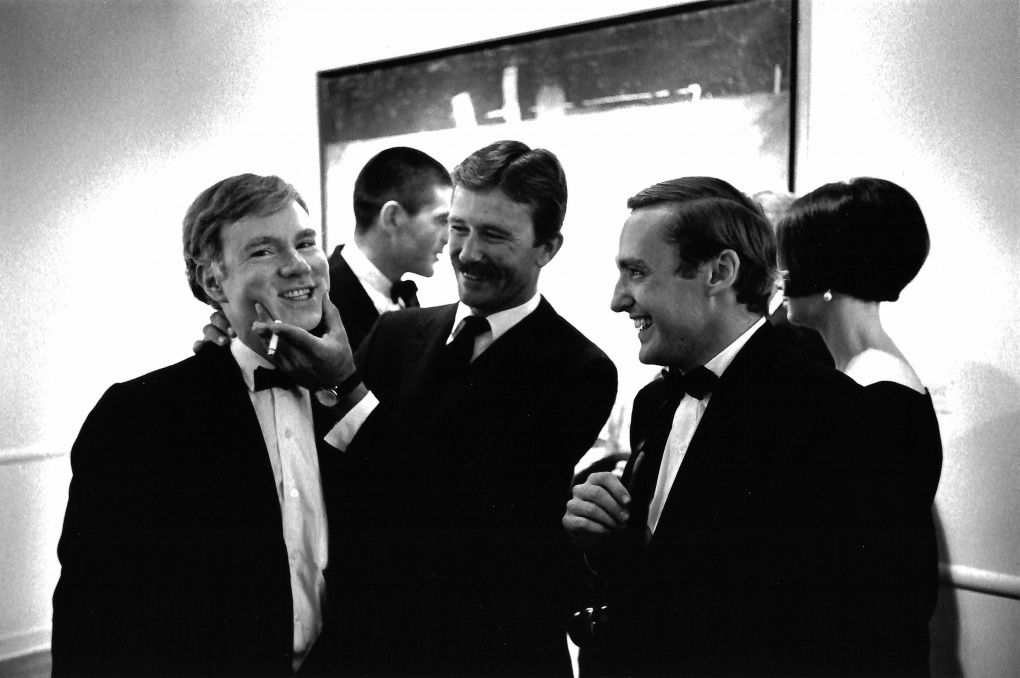
Andy Warhol, Irving Blum, Billy Al Bengston and Dennis Hopper, at the Opening Reception, Duchamp Retrospective, Pasadena Art Museum, 1963. Photo by Julian Wasser. © The Estate of Julian Wasser, Courtesy of Craig Krull Gallery, Santa Monica, CA.
Wasser’s most famous session, though, is really the ballad of Eve Babitz15, the second-ranked doyenne of L.A. arts and letters, the id to Joan Didion’s superego. A flowchart of the resulting images, of a naked 20-year-old Babitz playing chess with Marcel Duchamp, goes something like this:
– Walter Hopps, married, is in a sexual relationship with Babitz when he stages the Duchamp retrospective. Lest his wife run into her, he leaves Babitz off the list for the private opening, on October 7, 1963.
– Wasser, unmarried, brings Mirandi Babitz, Eve’s even younger sister, as his date to the private opening, further annoying Eve, who also slept with Wasser occasionally.
– Wasser gets the idea to take Duchamp’s picture playing chess with a naked girl and asks Eve, Mulholland Drive “this is the girl” style, if she wants to do it.16
– Babitz, to get back at Hopps for the snub and to continue her documented pattern of starfucking, says yes.
– Duchamp, already 42 years retired, holds court one last time as reactionary du jour, in the empty gallery, across from Babitz’ big rack which hangs forbiddingly over the black pieces. Professionalism incarnate, he has eyes only for the board. We don’t know how many games they play, except that in the middle of one Hopps walks in. Wasser asks him to leave. Babitz, always finicky about her reputation and already something of a pro at power relations, said later: “Walter thought he was running the show, and I finally got to run something.”17
According to Wasser, this is the picture “every artist on the planet has seen.”18Nourished by gossip and the incestuous personal lives of the principals, it’s a cloverleaf interchange of time and allusion—as Duchamp’s proto-Pop heroism fades into the dark science of chess, Babitz balances a groupie’s multiple storylines toward literary easement; Wasser flashes a bit of photographer’s roguery; and finally, art history’s hinge completes its turn toward Los Angeles, city of exits.
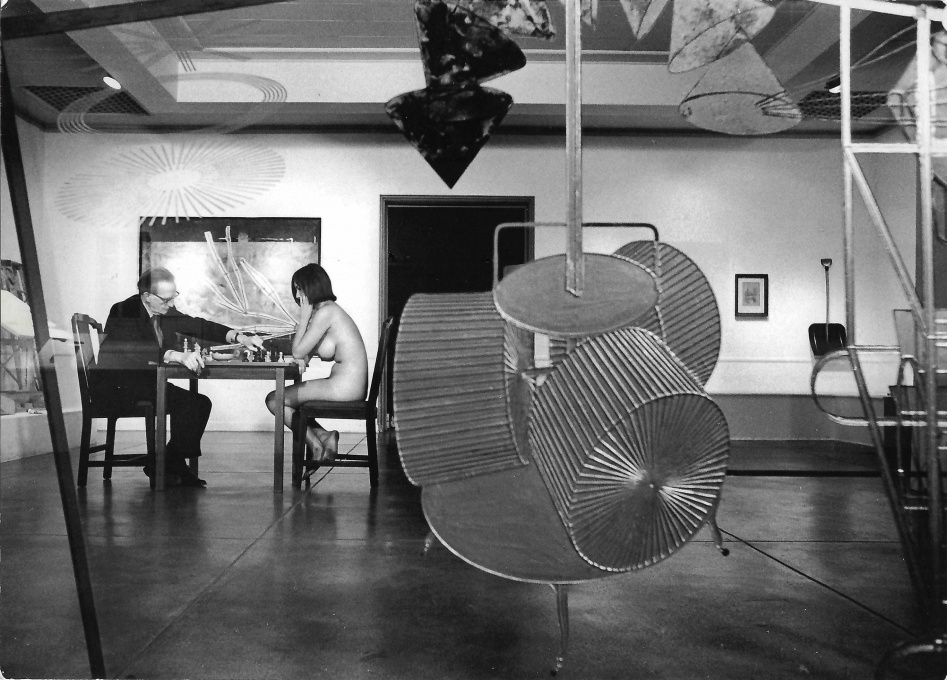
Julian Wasser, The Bride Stripped Bare (Eve Babitz) and Marcel Duchamp, 1963. Vintage silver gelatin print. 7 inches x 9 3/4 inches. © The Estate of Julian Wasser, Courtesy of Craig Krull Gallery, Santa Monica, CA.
Steve Smoking: 1963
One of cool’s epitomes during the Wasser years, if not its standalone statue, was Steve McQueen. That’s his profile on the cover of The Way We Were, on the set of Love with the Proper Stranger, in a suit and sunglasses, demonstrating a Nabokov line I’ve always loved: “He exhaled a megaphone of smoke.”19 McQueen, ex-Marine and man’s man, ran five miles a day, raced cars on film and off, flew and owned vintage aircraft, and was a pallbearer at Bruce Lee’s funeral, all while smoking prodigiously until, in 1978, he got a cough. It wouldn’t seem like a mysterious one, but the inevitable lung cancer diagnosis was instead one for mesothelioma, caused by asbestos exposure. McQueen blamed the racing suits, but also the insulation in movie soundstages.
Wasser’s picture of McQueen is one of his silveriest exposures, mimicking the stark color usage in paranoid-schizophrenic ‘60s action films like Point Blank and Le Samourai, and while the smoke might be the whole point, the question of who is smoking is not so simple. Yes, it’s McQueen, but the smoke might as well be from a gun. Lost in early-onset paranoia after the Manson murders, McQueen heard a rumor that his name was on a list of further targets and started wearing a firearm, including to Jay Sebring’s funeral. Deep into his cancer, he died in Mexico, after an off-grid operation to remove a 5-lb tumor from his liver.
Joan: 1968
Which do you notice first, the woman or the car? “The images became part of the narrative,” Tracy Daugherty wrote: “People thought they knew this woman.”20Her face ended up on tote bags21 and in fashion editorials, her name tattooed on palms and shoulders. Her sentences seduce and destroy, their imitation a cottage industry.22If we have any clue who this preternaturally candid, elfine, probably-on-the-spectrum dispassionista was, it’s in Wasser’s 1968 shoot commissioned by Time during the rollout of Slouching Towards Bethlehem.23 There are three shots of Didion and her Daytona yellow Corvette Stingray next to her Greek-columned, French-doored house on Franklin Avenue. In the first, Didion stands slightly askew with the Stingray insignia at right flank, the sinew of the driver’s side fender mirroring the hinted-at sinew under the caftan she’s wearing, the fender, wheel well, and tire hugely proportioned, cigarette newly alight, match hand blurred as she fans the light out, the two-door garage angled behind. In the second, Wasser positions her on the y-axis to the Corvette’s x-, still smoking, her face down a variable to an almost-frown, the garage zoomed-in. In the third, she’s finally entered the car and sits in the driver’s seat, the cigarette down a peg, her eyes also. The garage has disappeared and she’s already left the scene, freeways in her immediate future.
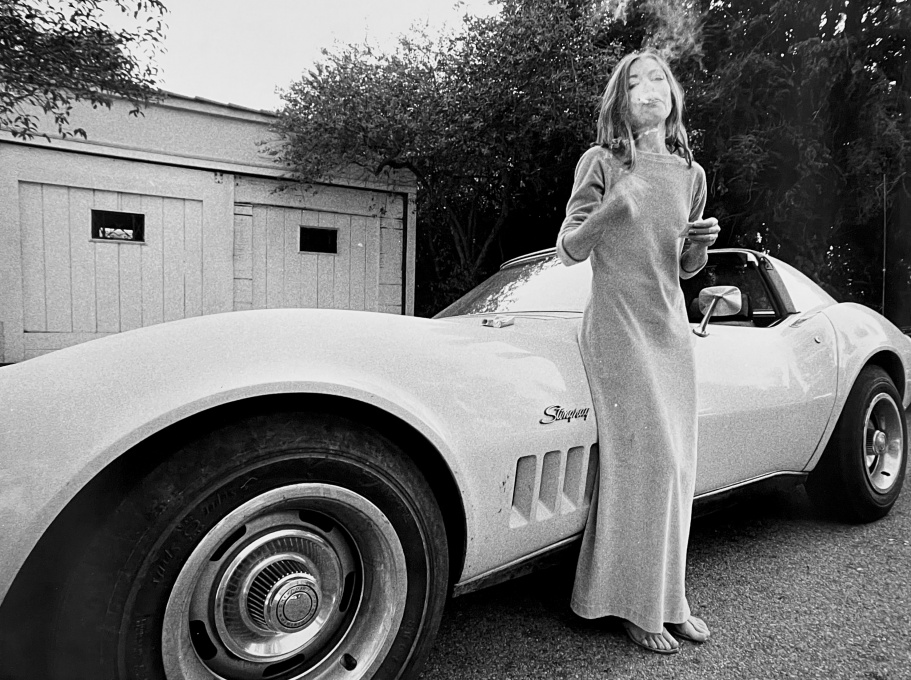
Julian Wasser, Joan Didion Smoking in front of Her Stingray, 1968. Vintage gelatin silver print. 10 1/4 inches x 13 7/8 inches paper size. 9 7/8 inches x 13 3/8 inches image size. © The Estate of Julian Wasser, Courtesy of Craig Krull Gallery, Santa Monica, CA.
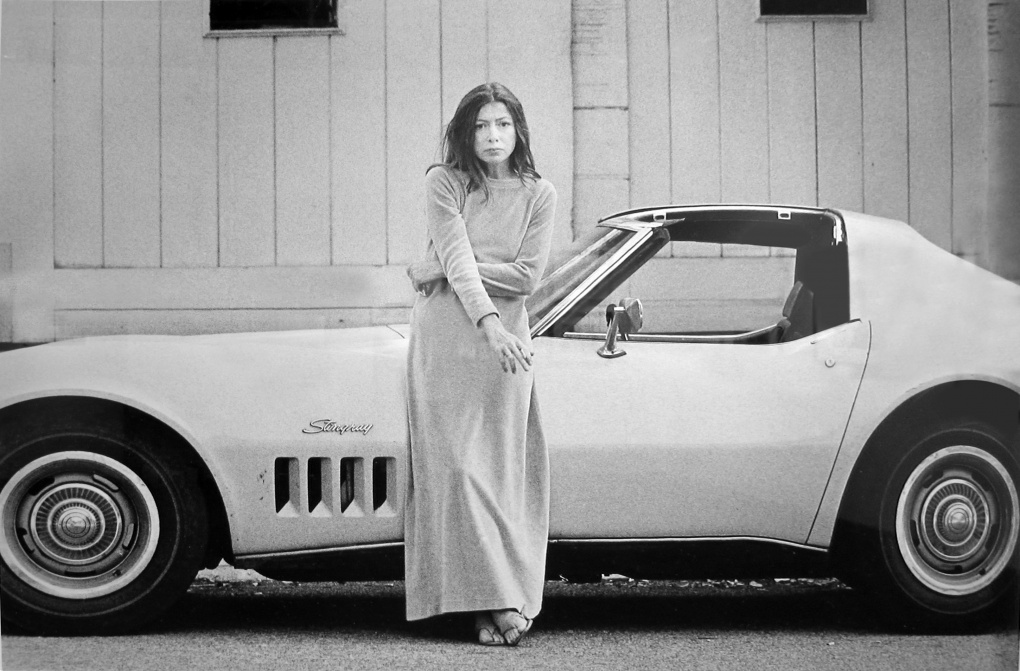
Julian Wasser, Didion in front of Her Corvette, 1968. Gelatin silver print, printed c. 2010. 20 inches x 24 inches. Edition of 15. © The Estate of Julian Wasser, Courtesy of Craig Krull Gallery, Santa Monica, CA.
In a way, Wasser brings it back to Warhol, to the hundreds of car illustrations the latter did of new Buicks and Cadillacs for Harper’s Bazaar in the ‘50s. Working with materials like silver paint, Strathmore paper, and art gum erasers, Warhol used cars to transition from shoes to soup cans, when his experimentation with the everyday was still called Commonism and not yet Pop Art.24Wasser’s picture of Didion with the Corvette foregrounded resembles Warhol’s acrylic silhouette of a 1962 Lincoln Continental in three-quarter view with the front wheel well cleanly cut out. A Warhol watercolor, from 1959, Female Fashion Figure (with 1959 Plymouth Sport Fury Convertible) both mimics the rhythm of print advertisement and prefigures Didion angled next to the Corvette.
Didion’s oft-alluded-to (by her and everyone else) petiteness appears swallowed by the muscle car, a clearly deliberate choice. Women didn’t drive these kinds of cars that often. Although Didion always downplayed any autobiography in it, Corvette imagery courses through her 1970 novel Play It As It Lays (Maria Wyeth also drives one, also Daytona yellow): “So that she would not have to stop for food she kept a hard-boiled egg on the passenger seat of the Corvette. She could shell and eat a hard-boiled egg at seventy miles an hour (crack it on the steering wheel, never mind salt, salt bloats, no matter what happened she remembered her body) and she drank Coca-Cola in Union 76 stations, Standard stations, Flying As.”25And: “She walked back to the car and sat for a long while in the parking lot, idling the engine and watching a woman in a muumuu walk out of the Carolina Pines Motel and cross the street to a supermarket.”26
Wasser firmly seals the indescribable Didion aura that e-girls and essayists, talented and otherwise, try to bottle to this day, usually unsuccessfully. Wasser was attracted to the claim that in L.A., sometimes what you see really is what you get, a Warholian piece of advice if there ever was one. His photographs of Didion feature everything in its right place, from woman to car, and yet most of it was fleeting. The Corvette Stingray was famously a terrible model,27flashy yet falling apart, and Didion eventually traded it in for a Volvo station wagon, but if there is a famous editorial featuring a woman and a Volvo station wagon, I have not seen it.
Two Houses: 1969-1974
As found in Didion’s famous report on the Manson murders: “Many people I know in Los Angeles believe the Sixties ended abruptly on August 9th, 1969.”28In the days after, as the city filled to capacity with fear, Wasser, on assignment for Life, accompanied Roman Polanski to the house on Cielo Drive. The little man we see is 5’3 Polanski, husband to Sharon Tate, crouching next to the most notorious front door in true crime, the one with PIG scrawled in his pregnant wife’s blood. To the left is Wasser’s Polaroid camera, placed on a chair. The little man we don’t see is 5 ‘2 Charles Manson, who pollutes the picture from whatever hidey-hole he was in then, before everyone knew his name. Wasser channels Weegee here but also poses a ghastly question, not What’s wrong with this picture but Who’s not in this picture? Not the murdered pregnant wife, and not the murderers, not physically, yet Manson’s there, his fingerprints all over it. In a second picture at the scene, we see a bloody bedroom phone next to a framed Tate-Polanski wedding photo. Polanski is not shown, except once removed; Manson, again, is both shown and unshown. Both pictures are all aftermath, empty of respite and saturated with recency.
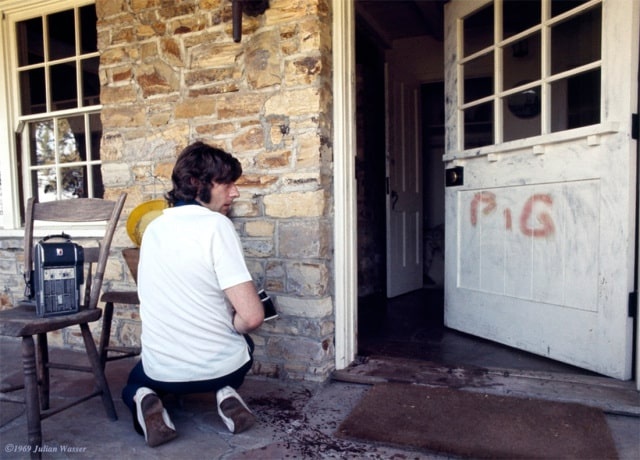
Roman Polanski on Cielo Drive at the scene of the Manson family killings, 1969. Photo © Julian Wasser. Courtesy of The Estate of Julian Wasser.
Five years later, Wasser’s photograph of Jack Nicholson and Anjelica Huston, at Jack’s house for Stern magazine in 1974, features the legendarily storm-tossed couple in post-pool play—Jack in a bathrobe and fedora, Anjelica in a white bikini. Background right are walls of sleeved records, as Anjelica casually handles unsleeved ones in the right foreground. In the center, over the record player, a framed ganja print hangs. The term “Jack Nicholson’s house” turns like a tossed token, backward to the star system and forward to Nicholson’s present as 89-year-old Archbishop of Hollywood who’s rarely seen in public. Bought in 1969, the Mulholland Drive residence, with sweeping views of both the Valley and Beverly Hills, slowly doubled in value and swallowed adjoining properties in an attempt to further bunker Jack—one of those properties being Marlon Brando’s, so close you could smell the shit when Brando decided to redesign his sewage system. Obviously, views inside the sanctum are rare.
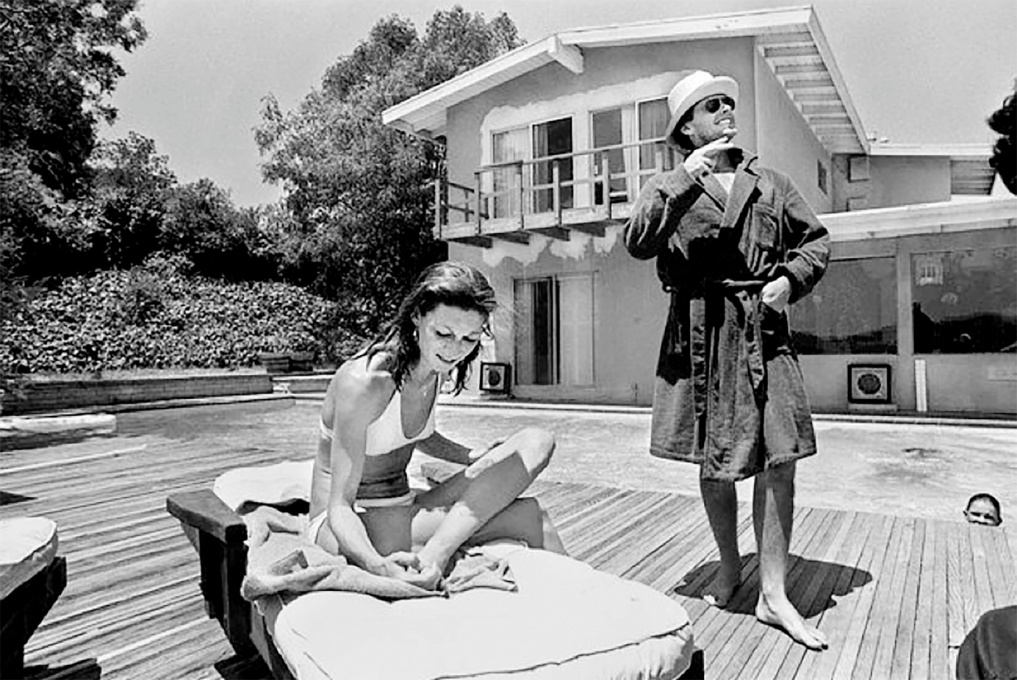
Anjelica Huston and Jack Nicholson by the pool, 1971. Photo © Julian Wasser. Courtesy of The Estate of Julian Wasser.
Even after she moved in, Huston would occasionally come back and find the place redecorated, the walls repainted, for example, and newly acquired art as Jack built his collection. He also collected pigs—ceramics and tchotkes of them. People mailed Jack pigs, and he put them in his house. The sudden reconfigurings are Mansonesque; one of Charlie’s favorite psyops involved break-ins simply to rearrange people’s furniture. He called it “creepy-crawling.” He is also said to have visited the Cielo scene after the fact to art-direct, getting the angle on an American flag just right, among other things. When the particularity of image-making sifts into crime scenes, second-order effects start adding up. According to Wasser, a psychic stole his Polaroids and sold them to the tabloids.29Anjelica and Jack split for good in 1989.
Farrah’s Feathers: 1976
The 1970s weren’t any more innocent, except on television, where pretentions toward the risqué just look fun and healthy now. The first episode of Charlie’s Angels, about three female P.I.s who do the bidding of another, unseen male P.I. (this was supposed to be feminist) aired on ABC on September 22nd, 1976.30Aaron Spelling, the show’s producer, insisted the stars had to do all media on their lunch breaks, so Wasser, sent by People, photographed Farrah Fawcett in her trailer, looking annoyed. She’s drinking a Tab. She’s writing something in her journal, or so Wasser said—she’s writing something, anyway. The show is barely off the ground, as is Fawcett’s fame, while the hair that launched a thousand glam metal bands is already aflight, cascading into tiers of lacquered frost. Wasser tracks the hair from test phase to launchpad, up in curlers at 7 a.m. and later in front of a handheld butterfly-art mirror, brush held in the other hand. The picture that People put on the cover is of all three Angels (Fawcett, Jaclyn Smith, and Kate Jackson), holding two guns and a walkie-talkie, respectively.31 Wasser’s work in the ‘70s reflects the seedier, pornier turn the counterculture took: Hugh Hefner and a flock of bunnies, the New York Dolls against a wall like a lineup of vice arrests, Iggy Pop getting whipped by a Nazi fetishist onstage, Phil Spector leering at Debbie Harry. Charlie’s Angels happened near the apex of all that, but the People shoot is still on a seesaw of clean, with Fawcett its fulcrum. I’m sorry to put it like this, but Fawcett was sort of the Sydney Sweeney of her time, newly interrogating what it meant to be an All-American girl in the ruins of Marilyn Monroe. Gone were the Sebergian, Farrowian gamines of the ‘60s as the blowdryers of hyperfeminity kicked in.
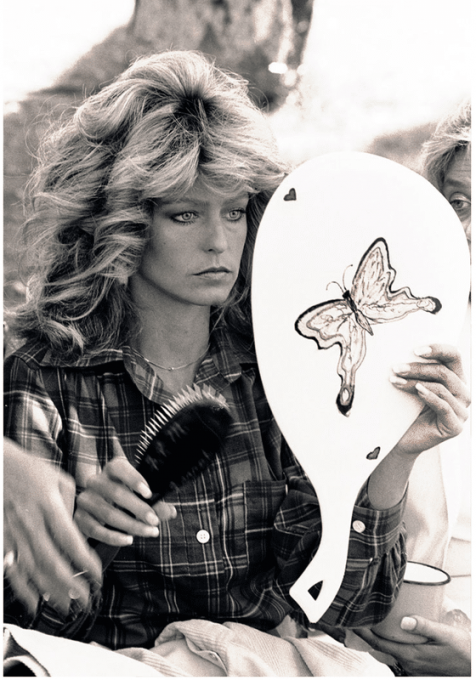
Farrah Fawcett on the set of Charlie’s Angels, 1976. Photo © Julian Wasser. Courtesy of The Estate of Julian Wasser.
Like Steve McQueen, Fawcett died horribly, from anal cancer. Her funeral, in 2009, was the inadvertent site of an ignominious, industry-indicting faux pas committed by the Hall of Fame philanderer Ryan O’Neal, whose long list of exes included Fawcett.32The story goes, as told by its subject, that he approached a hot blonde he didn’t recognize. “Daddy, it’s me!” said the blonde. It was his daughter, Tatum O’Neal.33
Watts: 1965
Wasser’s shadowing of Weegee shows up in what look to be staged, but aren’t really, shots of police vs. civilians in Watts. Say the word “Watts” 60 years later and tendencies pile up, sorted into two buckets—“Riot” or “Rebellion.” The notorious LAPD chief Daryl Gates, then an inspector, wrote: “It was impossible to describe the utter chaos, or how confused we felt… I kept searching for a great big crowd that I could confront with all the tactics I had learned.”34What started as a drunk-driving arrest led to disparate groups—only a minority of the neighborhood, Gates insisted—setting fires and looting stores. It’s true that in the weeks prior, a white LAPD officer was fired for raping a black woman, the case circulating in black media but never fully breaking containment, and that’s what Watts blew up over, not a failed sobriety test. (There was also a heat wave, which is always when these things happen.) Mike Davis and Jon Wiener, in their book Set The Night On Fire, refer to the woman, Beverly Tate, as “a ghost in the crowd”35—another Wasserian figment. In what looks like a furniture store, Wasser finds an officer pointing a shotgun at four suspects prone on the carpet. In another shot, an officer, again with a shotgun, controls eight suspects ranged under wall signage that reads MARKET above and Meats Produce below. Photography like this isn’t interested in context; Wasser didn’t see the police as brutal occupiers and the civilians as brutally occupied, or the police as vital defenders and the civilians as malicious destructors. Despite how posed everyone looks, and the strong hint of smoke probably leading to fire, all he did was follow the scanner.
After seven days of disorder, LAPD claimed victory in Watts. Over 3,000 people were arrested in the riots, or rebellion, with the McCone Commission, formed by Governor Pat Brown to get to the bottom of what really happened in Watts, never really getting to the bottom of anything. Gates, who always stuck to his story about social contagion, went on to invent SWAT, fully militarize LAPD, and then publish Chief, his 1992 autobiography, as image control after Rodney King.
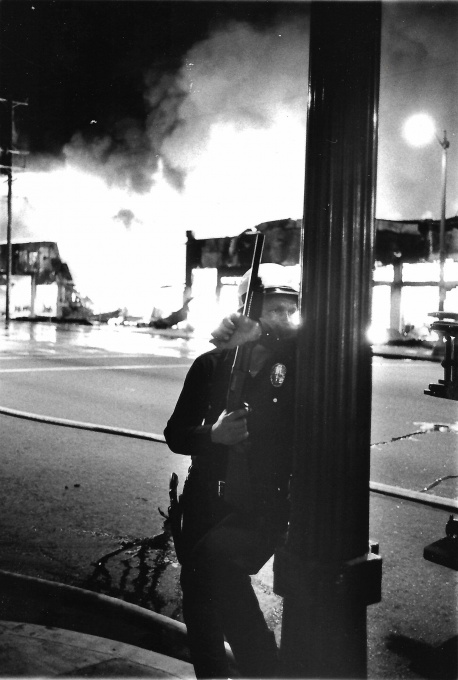
Julian Wasser, Watts Riots, 1965. Vintage gelatin silver print. 9 7/8 inches x 6 7/8 inches paper size. 9 1/8 inches x 6 1/4 inches image. © The Estate of Julian Wasser, Courtesy of Craig Krull Gallery, Santa Monica, CA.
1968: Bobby, Minutes Before
Probably no Wasser image marries his news training to his fame-seeking, or slow-dissolves his two cities, D.C. and L.A., into more of a fixed point than Robert F. Kennedy at the Ambassador Hotel on June 4, 1968. Bobby, facing the jubilant crowd, appears jostled by his own supporters, fighting for space like an ensemble cast accepting a SAG award. Everything is in place: the V for victory, the hair with its rascally side flop, the earnestness and the ambition and the hope—all for nothing when the shots ring out. It’s all myth now and the killer’s motivations were put in mothballs long ago, like the hagiography of Kennedy himself. Whether you think Sirhan Sirhan was an MK-Ultra zealot who acted semi-alone, or just another patsy, Wasser’s picture nails a criminal conspiracy in motion as an entire wing of the postwar project is about to be demolished.
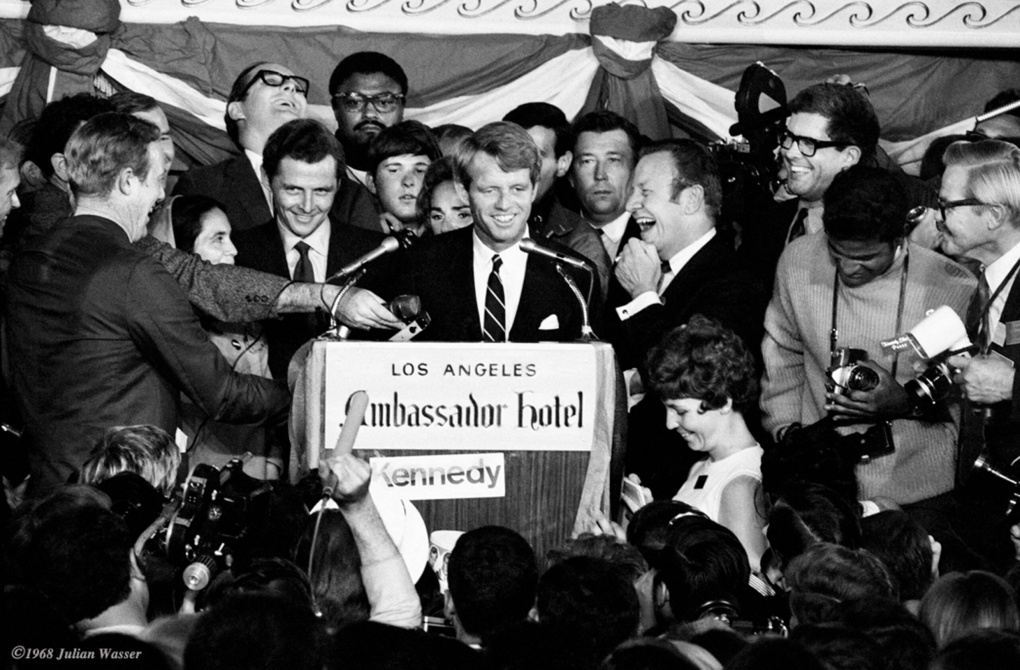
Julian Wasser, Bobby Kennedy, 1968. Gelatin silver print, printed c 1980’s. 6 7/8 inches x 9 1/4 inches. © The Estate of Julian Wasser, Courtesy of Craig Krull Gallery, Santa Monica, CA.
1982: Belushi, Hours After
Probably the ‘70s ended with John Belushi’s speedball at the Chateau Marmont, the beloved comedian cradled by his dealer as he died. If anything, the cocaine boom in the United States wasn’t because increased free trade created higher incentives to farm and smuggle, it was because Hollywood rediscovered it after a long hiatus. Daryl Gates felt no sympathy at all.36Some believe Belushi’s dealer, Cathy Smith, was an LAPD informant and his death came at the end of a sting by the department, that Robin Williams and Robert De Niro were also targets and had the good fortune, or were tipped off, to leave Belushi’s room by 2 a.m.37The next day, as rings of tigerish media turned the Chateau into a grisly circus, waiting for Belushi’s body to be brought out of Bungalow 5, Wasser climbed a roof to get a better look. The lush greenery of Marmont Lane yields to a brown van with “CORONER” on the hood; the driver’s arm hooks casually out the window, his watch on too tight, the photographers’ many bald spots exposed in the afternoon light. Absence again: the subject of the picture is not in it, the credentialed vultures haven’t yet seen what they came to see, and we can only peck at their eyes.
Not long after the Belushi overdose, LAPD sponsored a billboard next to the Chateau Marmont, with the tagline Welcome to the glamorous world of cocaine! superimposed on an image of tagged bodies in a morgue.38 Wasser died in 2023, lauded variously as “the Cartier-Bresson of La-La-Land”39and “the closest thing that Los Angeles has had to a poet laureate.”40Having survived the slow takeover of visual culture by the pitch deck, his pictures still hang high.
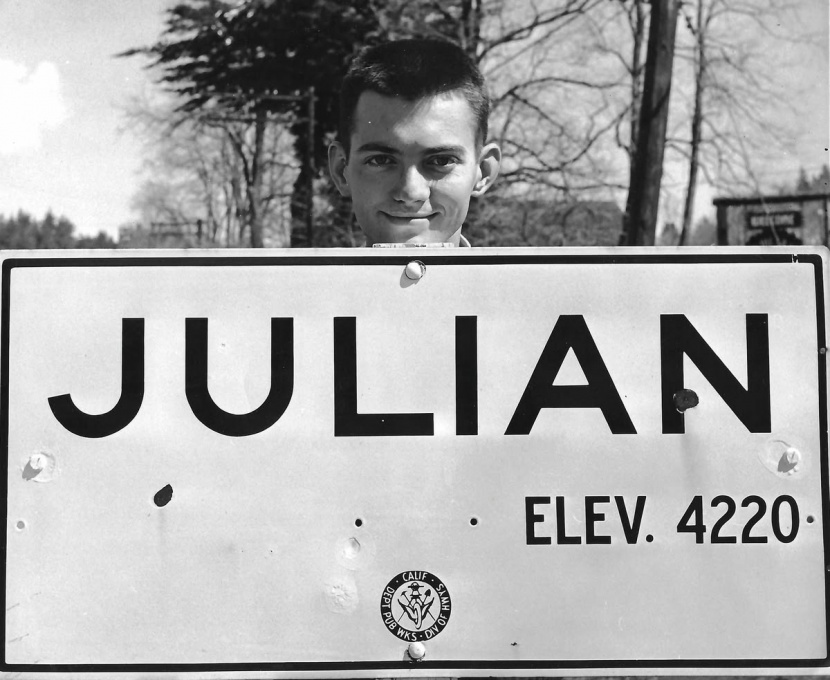
Julian Wasser, Julian Sign, c. 1960. © The Estate of Julian Wasser, Courtesy of Craig Krull Gallery, Santa Monica, CA.