Lauren Halsey: Architect of Communal Dreams
by Eddy Gibb
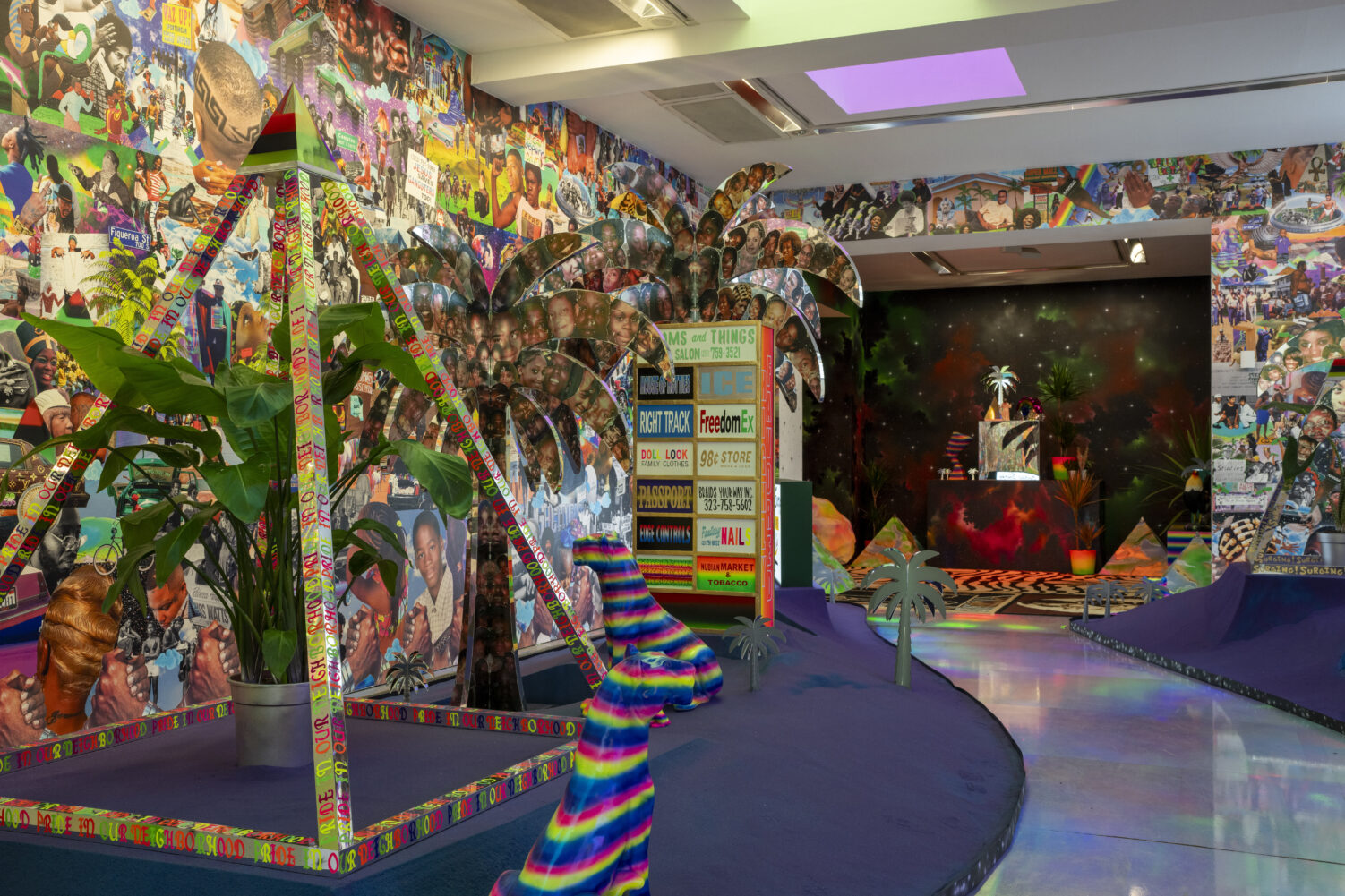
Lauren Halsey, emajendat, 2024. Installation view, Serpentine South. © Lauren Halsey. Photo: © Hugo Glendinning. Courtesy Serpentine.
The panthers had bathed in a neon rainbow; they lounged around modelling bright bands of pink, purple, green, and yellow. Their territory within Serpentine South Gallery from October 2024 to February 2025 encompassed both the real and the fantastical: the reflective frames of head-high pyramids covered in catchphrases like “PRIDE IN OUR NEIGHBORHOOD”; metallic palm tree models covered in collages of smiling faces; shop and road signs (“Compton NEXT 3 EXITS,” “CRENSHAW Discount Store,” “LATASHA HARLINS PLAYGROUND Welcomes You…”); and multiple scattered busts of a woman with her huge hair, a psychedelic polychrome cosmos, thrown back and her neon lips parted in a scream of ecstatic release. The locations are in South Central L.A., the figures its inhabitants. Transporting this world to London’s West End, the winding installation of Lauren Halsey’s UK solo debut, emajendat, incubated a joyful, dreamlike vision of her community.
The hallucinatory contrasts and wild colors might risk spawning an artificial Willy Wonka Candyland—sickly sweet, detached from reality. But while Halsey’s artworks are paradises of sorts, they’re never pure imagination. The metallic palm trees and their smiling faces were actually a community memorial: the young women depicted were the victims of South Central serial killer the “Grim Sleeper,” tragedies whose aftershocks Halsey witnessed firsthand growing up.1There were also newspaper cutouts of Civil Rights victories and tragedies among emajendat’s dense underfloor collages, Ancient Egyptian-style stelae for Black scholars, small sculpted books by African-American writers (“Rock My Soul: Black People & Self-Esteem,” “Black Labour White Wealth”). On one book there was a bubble-lettered note: “We want a full and complete freedom.” Though Halsey’s vision of African-American experience is overwhelmingly optimistic, she ensures we can’t forget where it’s rooted. That’s why emajendat’s larger-than-life-size sculptures of young people—a girl crouching to draw, a smiling, spaceman-costumed boy cradling a silver globe—seemed so heartwarmingly hopeful. Blending reality and fantasy in a funk-inspired spirit of creative freedom, improvisation and play, it’s the visual jamming of a self-declared “hardcore ‘Funkateer.’”2
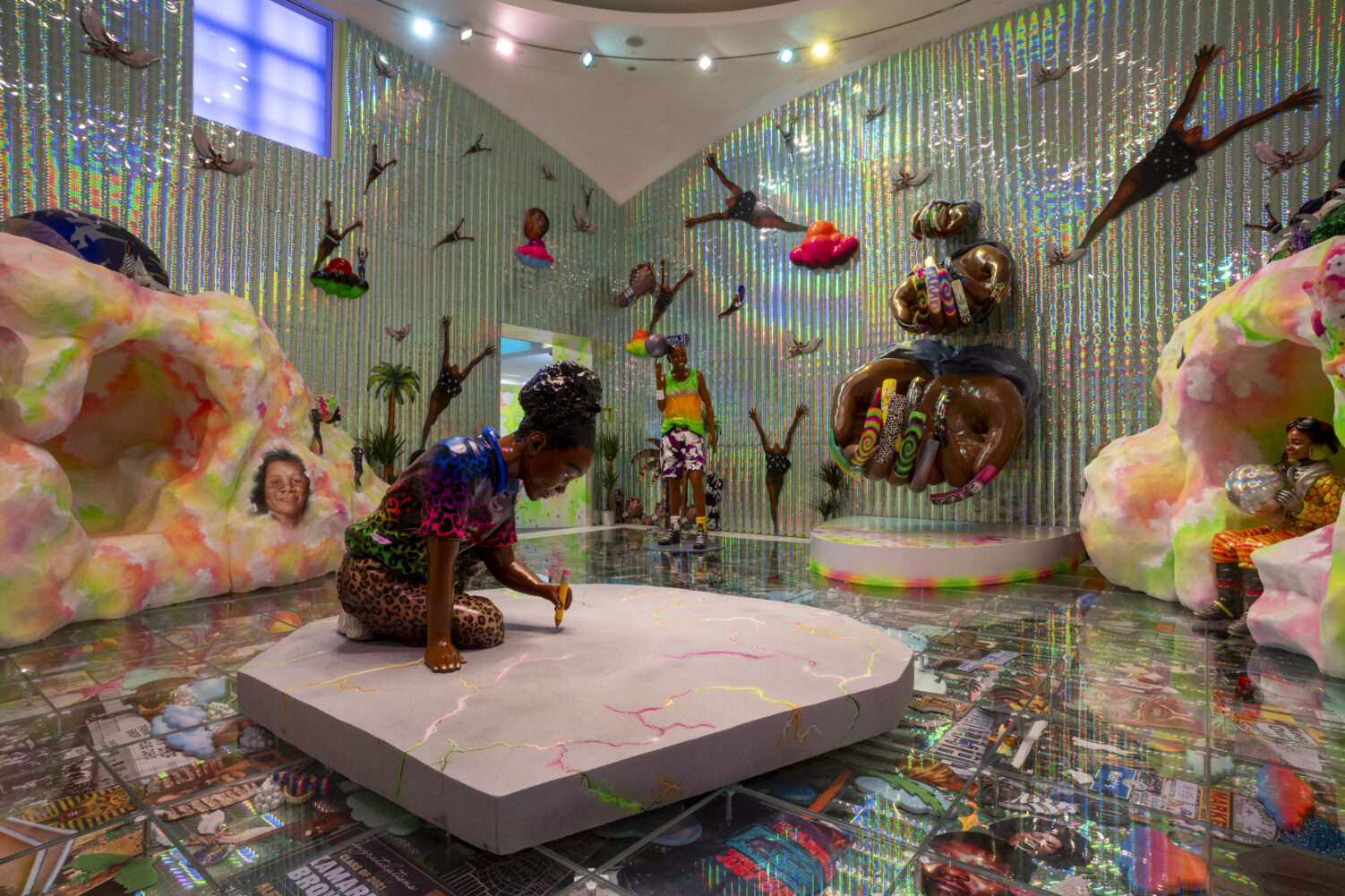
Lauren Halsey, emajendat, 2024. Installation view, Serpentine South. © Lauren Halsey. Photo: © Hugo Glendinning. Courtesy Serpentine.
Though also exploring video, 2D, and 3D media independently, Halsey is best known as an artist of large installations—particularly her full-scale Angeleno-Egyptian temple, which ascended to the New York skyline via the Met’s rooftop in 2023. This emphasis on scale places Halsey’s art within a 21st-century enlargement trend. As Hal Foster put it, “to make a big splash in the global pond of spectacle culture today, you have to have a big rock to drop.”3Noting the growth of “an art of size,” James Meyer complained that scale is nowadays “often marshaled to overwhelm and pacify,” rather than “inducing awareness and provoking thought.”4Though certainly guilty of possessing big splash “instagrammability,” Halsey’s spectacles sidestep the scale superficiality trap. Large environments frame her South Central community, generating spaces where individual lives are nurtured and protected—take Halsey’s monumental columns at the 2024 Venice Biennale, where the faces of her friends, family, and inspirations smile out like benevolent gods. It’s a notably harder task to bring gravity to optimism than to pessimism: Halsey’s achievement is formidable.
World-building: Spaces of Monumental Optimism
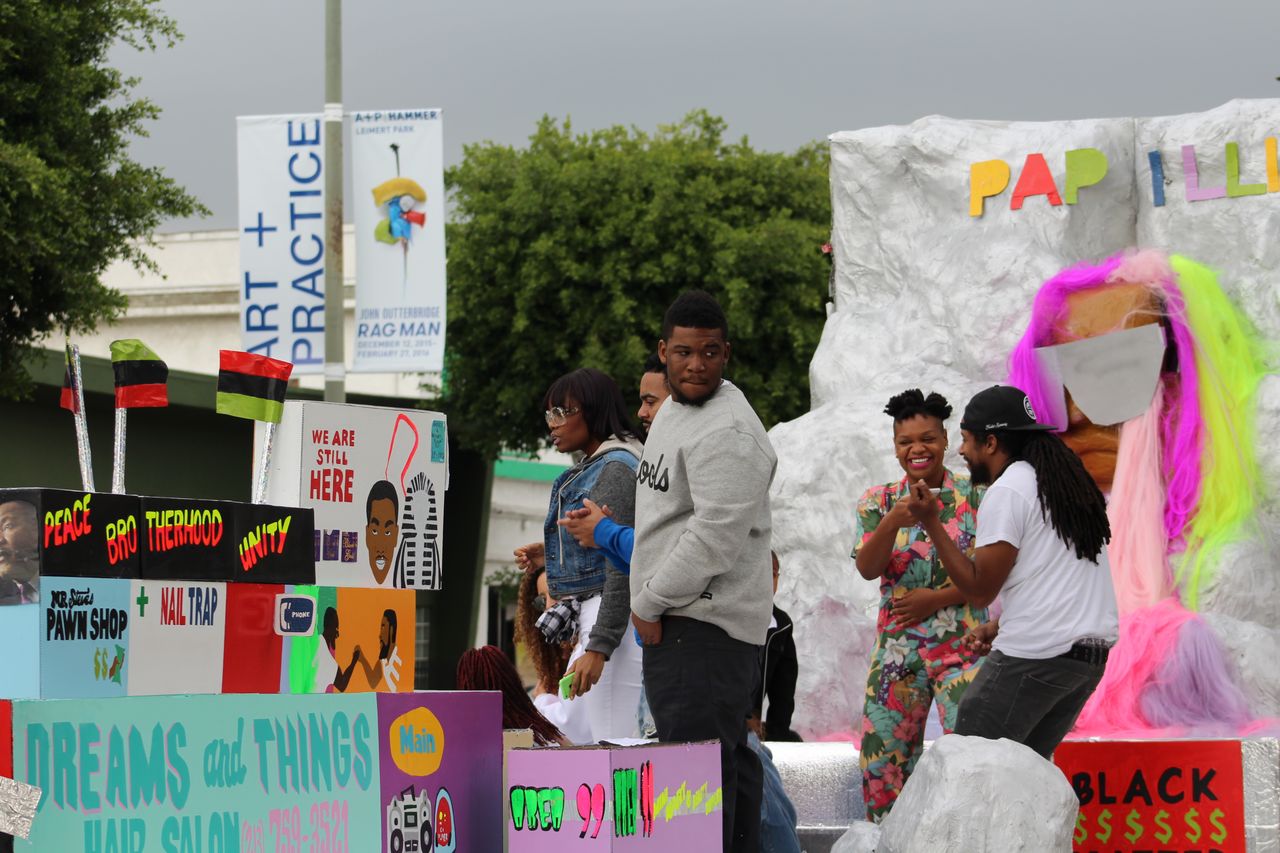
“Pride In Our Neighborhood” Float, The 31st Annual Kingdom Day Parade, Los Angeles, 2016. Courtesy of the artist. Photo: Papillion.
Halsey’s family has lived in South Central since 1922; it’s where Halsey grew up and still lives.5Halsey’s art has always sought to navigate through numerous mischaracterizations of her home. At one level, there’s delirious positivity: the L.A. fantasy driven by Hollywood as “Dream-factory of the Western World,”6rooted in 1920s myths of L.A. as a workers’ paradise.7At another level, relentless negativity: skewed stereotypes about South Central’s criminality attached to particular flashpoints like the 1965 Watts Rebellion, and perpetuated by L.A. noir film and literature. Halsey’s first large-scale, public, post-art school work was her “Pride In Our Neighborhood” Float (2016), built with friends for South L.A.’s 31st Annual Kingdom Day Parade (in honor of Martin Luther King Jr.). The huge flatbed truck presents space for people to sit among bright signs (“BLACK $$$$$$ MATTER”), paintings of Black women with wonderful multicolored hair, and a serene, silvery mountain zone. Long before lofty international exhibition spaces, Halsey had already begun testing lofty ambitions on behalf of—and collaborating with—her working class community: how to perform the balancing act of simultaneously grounding fantasy and casting off negativity.
Unsurprisingly for an artist working at such scale, the main arena for this balancing act is the L.A. cityscape itself. Halsey initially studied architecture, and would “dream up […] spaces” she wanted to see in empty lots around South Central.8Halsey’s are neighborhoods at risk, lacking structures by Black or local architects, and with residents priced out by mega-projects like the $5 billion SoFi Stadium.9Though abandoning architecture training for art’s practical freedoms, Halsey still draws on architectural influences. Considering the Walking City proposals of avant-garde ‘60s British architecture group Archigram,10alongside the speculative projects of ‘60s Italian architecture collective Superstudio,11Halsey recruits radical, futuristic urban ideas for a more humble, concrete task: rejuvenating a neighborhood eroded by gentrification. we still here, there (2018) at L.A.’s MOCA, Halsey’s first major museum show, begins a lasting cave-building impulse: bright rock formations scattered with colorful plants and glittering mirror fragments, somewhere between ancient, pristine landscape and sci-fi-esque terraformed idyll.12 Norman Klein studied L.A.’s “history of forgetting” and its “tear down or else” attitude, its “anxiety to rebuild.”13Halsey’s environmental reverence, anchored in stubborn scale that refuses to budge, defies this anxiety.
Halsey’s other space-making impulse is a more backwards-looking integration of ancient monumental structures. The Crenshaw District Hieroglyph Project (Prototype Architecture) (2017-20) demonstrates Halsey’s early exploration of Ancient Egyptian architecture with a simple one-room structure of ancient-looking blocks engraved with modern graffiti rather than arcane hieroglyphs. The 2023 Met Roof Garden Commission (the eastside of south central los angeles hieroglyph prototype architecture (I)) successfully elevates the vision’s grandeur, adopting a much more sophisticated temple-complex structure, complete with sphinxes. This Ancient Egyptianizing leverages the same dignity that ancient monuments sought—“power petrified”14—when establishing rulers. Except here it’s democratized for South Central’s inhabitants and businesses via poster-like carvings: “The Braid Shack,” “Watts Skill Centre,” “BLACK WORKERS RISING FOR JOBS, JUSTICE AND DIGNITY.” The juxtaposition of ancient and modern echoes Kehinde Wiley, another artist from South Central, whose portraits often employ the art-historical tropes of traditional Western European portraiture to recontextualize depictions of 21st-century Black men.15Wiley’s Rumors of War (2019), for example, borrows a generalissimo’s prancing horse and dignified contraposto, but the subject is a young Black man, sporting a hoody and high tops, dreads flying.
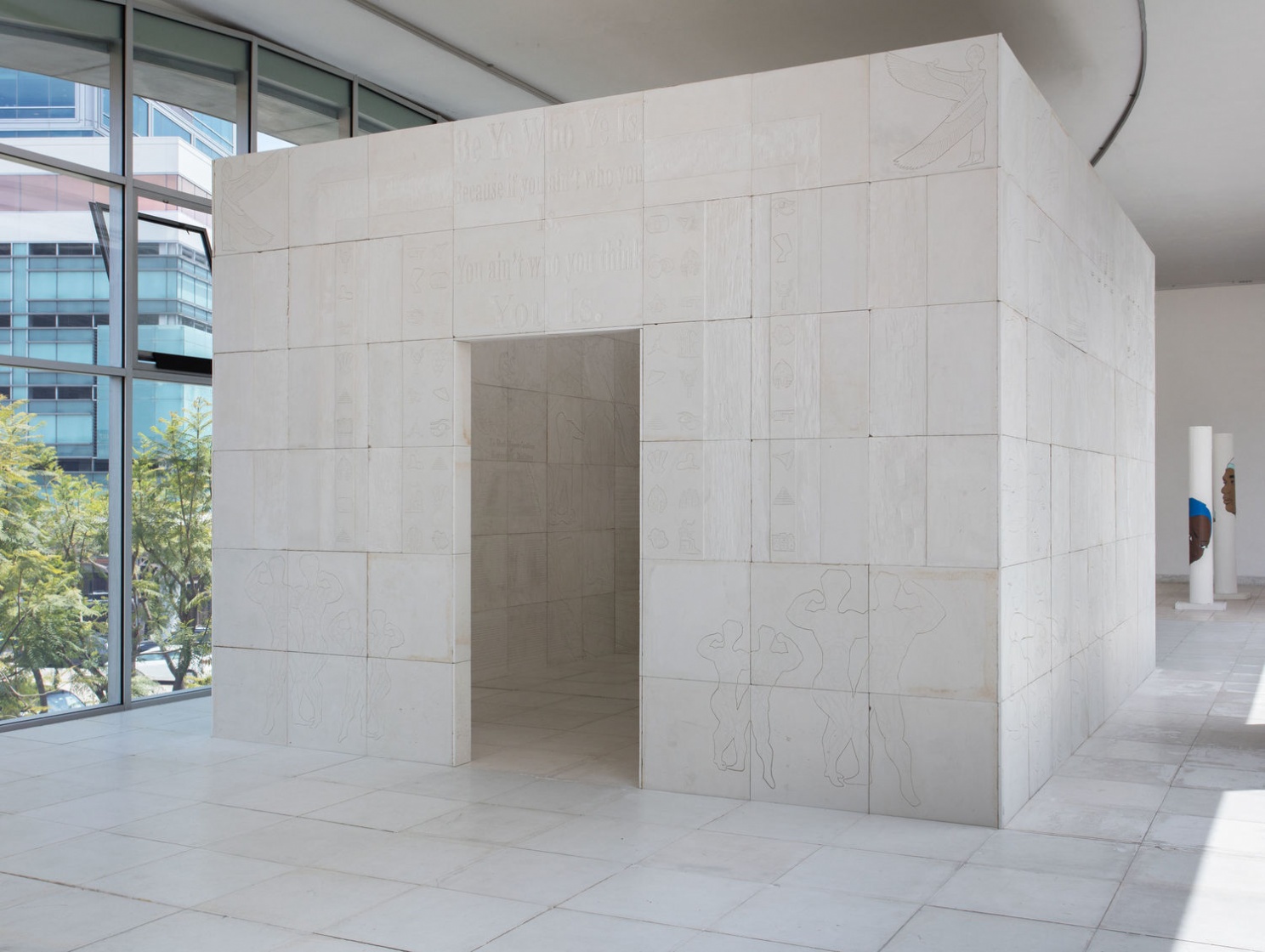
Lauren Halsey, The Crenshaw District Hieroglyph Project (Prototype Architecture), (detail), 2018 Installation view, Made in L.A. 2018, June 3-September 2, 2018, Hammer Museum, Los Angeles. Photo: Brian Forrest.
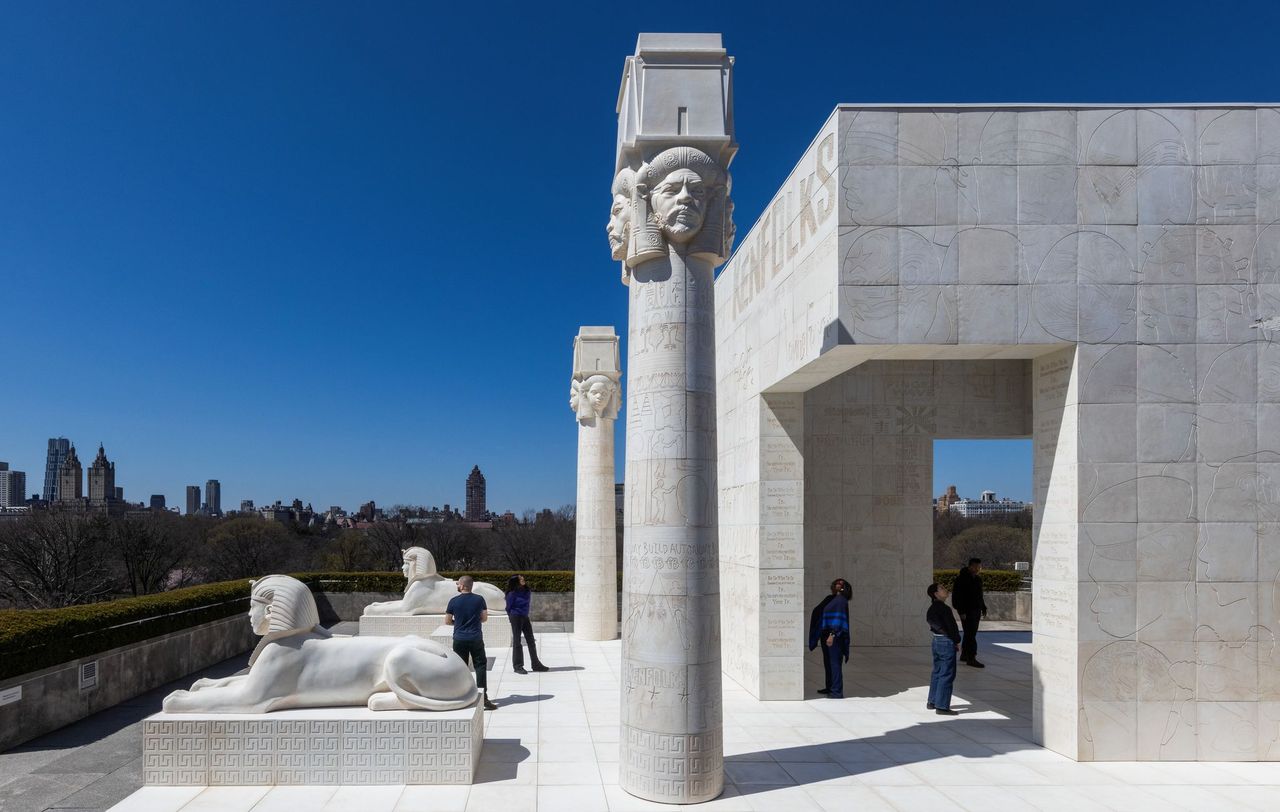
Installation view of The Roof Garden Commission: Lauren Halsey, the eastside of south central los angeles hieroglyph prototype architecture (I), 2022 © Lauren Halsey. Courtesy of the artist; David Kordansky Gallery, Los Angeles/New York. Image credit: The Metropolitan Museum of Art. Photo by Hyla Skopitz.
That artistic tradition eventually leads Wiley to the portraiture of Confederate leaders; Wiley’s prancing horse and contraposto rider copy a 1907 monument of Confederate general J.E.B. Stuart.16Though reacting very differently, over the last decade both Wiley and Halsey have worked through a period when the art of American public spaces has been extremely contested. Movements seeking the removal of Confederate statues (often erected long after the Civil War to bolster segregational white supremacist attitudes) have faced racist violence. In 2017, for example, white nationalist “Unite the Right” rallies in Charlottesville (featuring Klansmen and Nazi flags) demonstrated violently against the removal of Confederate statues.17MONUMENTS, an ongoing L.A. exhibition co-hosted between MOCA and The Brick, asks the debate’s central question: what’s the future of Confederate monuments and their public spaces?18Halsey’s answer is different from the “Great Man” mode of history and representation that Wiley examines. Halsey’s are not monuments of individuals, but of South Central’s community, proposing public spaces that are of the public. And the crowning of a whole community with an ancient and sacred regal status befitting Egyptian Pharaohs only becomes more powerful when a US president faces “No Kings” protests.
I briefly wondered if reinterpretations of Roman triumphal arches might be next for Halsey, following the Greco-Roman architectural heritage of the Capitol or Supreme Court. But in politically charged times, architecture—the means of projecting our identity outwardly and shaping our spaces inwardly—becomes charged too. Buildings, like monuments, stop being invisible. In August 2025, for example, President Trump signed an executive order requiring new federal buildings to follow the style of “classical architecture.”19It’s hardly surprising that Halsey’s first choice for her South Central community is not a visual language whose theory lies in Renaissance ideals of harmony and proportion, whose history is intended to evoke early exemplary political and legal systems—but which, in reality, presents institutions that have presided over slavery and the Jim Crow era. Whilst African-American artists can criticize by re-interpreting these structures (take Kiyan Williams’ Ruins of Empire II (2024), a crumbling, sideways-sinking Greco-Roman temple), Egypt offers fresh hope, a cleaner slate. Referencing the first century B.C. Temple of Dendur in the Met museum below, the implied patron deity of Halsey’s rooftop temple nurtures South Central: Isis, goddess of healing and magic.
But the hope that Egypt offers certainly comes with pitfalls. There’s a long history of African-American-Egyptian hybrid identification across the arts (the music, film and dress of Sun Ra, for example) and politics (the N.A.A.C.P.’s magazine cover depicted a sphinx).20This gained momentum in the 1990s when Martin Bernal theorized that Western historians, following Eurocentric colonial ideologies, had over-focused attention on “white” Ancient Greece and minimized cultural debts owed to “Black” Ancient Egypt.21Though since debunked on historiographical and archaeological grounds, there’s a more urgent issue. As John McWhorter notes, there are far more relevant (if less well-known) ancient African powers to connect with: the Atlantic Slave Trade mainly extracted people from West Africa, far from Egypt.22The long-term continuation of this “Black Egypt”23idea among US artists aims to dignify African-American histories, but simultaneously highlights an underlying tragedy: that Slave Trade heritage-severing created the need for fantasy at all.
Perhaps for Halsey the pitfall—the fictionalization—is the point. Confederate statues also fictionalize: the “Lost Cause” myth fantasizes retroactively about nobler reasons for the South fighting the Civil War. They and Halsey both mythologize, self-delude, romanticize. But while the “Lost Cause” is fantasy by omission, Halsey’s Egyptianizing is fantasy by addition: one somehow surreptitiously forgets a legacy of white supremacy, while the other openly builds an African-American future with dignity. Acknowledging the traumatic African-American historical disconnect within this wider contemporary context of monumental decolonization, Halsey’s art responds with characteristic brute-force optimism, smiling through the pain.
Remixing: Archives as Antidotes
This world-building provides protected spaces within exhibiting spaces, a framing device that stabilizes Halsey’s worlds—vital because their contents are bewilderingly diverse. The ephemeral and enduring co-exist alongside the big and small, casual and regal, old and new, real and unreal, public and private. In emajendat, a colossal statue of a grinning teen basketball player stands opposite a bearded Pharaonic bust with a multicoloured headdress. Halsey’s monumental structures, though less phantasmagorical, contain similar multitudes: in the Met commission, loose graffiti (“My Hood Gucci”) appears carved beside engraved replicas of typed adverts, “Prison Record Giving You Problems?” not far from “HOVERBOARDS” (phone number included). The word “maximal” is often bandied about in writings on Halsey, but rarely defined. If it means anything significant here, it’s in opposition to 1960s American Minimalism, that highly abstract purification of artistic excess. Ad Reinhart elaborates on the “less is more” mindset: “When the vulgar and commonplace dominate, the spirit subsides […] The laying bare of oneself, autobiographically or socially, is obscene.”24Rejecting the Minimalist vision of vulgar external realities, Halsey’s installations become community scrapbooks which imply that “pure” art is undesirable, impossible or both—joyless, purposeless, ivory tower art.
But does Halsey merely inspire madness instead of joy? Do we get lost in a maximal jumble? Halsey’s installations are labelled “psychedelic” and “dream-like”, words that too superficially hope to justify chaos. Similarly, “remix” is thrown around in reviews, often without respecting music’s centrality to Halsey’s creative philosophy. Halsey has loved funk music since childhood, particularly Parliament-Funkadelic (or P-Funk) and its lead, George Clinton.25Halsey’s art often makes specific funk references: in emajendat, there’s a statue of a skateboarding boy holding a jazzed-up US flag emblazoned with “ONE NATION UNDER A GROOVE,” the title of Funkadelic’s 1978 album. Halsey also calls her cave-like features “funk mounds,”26and her Ancient Egyptian themes owe plenty to funk, too: for example, the cover of Parliament’s 1980 album Trombipulation depicts an elephant-trunked sphinx in front of the pyramids.27But encompassing all this, Halsey channels funk’s mode of creation, which celebrates the freedom of improvisation and genre-blending. Nothing to unify it all? Tough: that’s the point. In Halsey’s words, “Once you define funk, it’s not funk anymore.”28Halsey’s funk-inspired “remixing” pays homage to this ambition of uninhibited creative freedom.
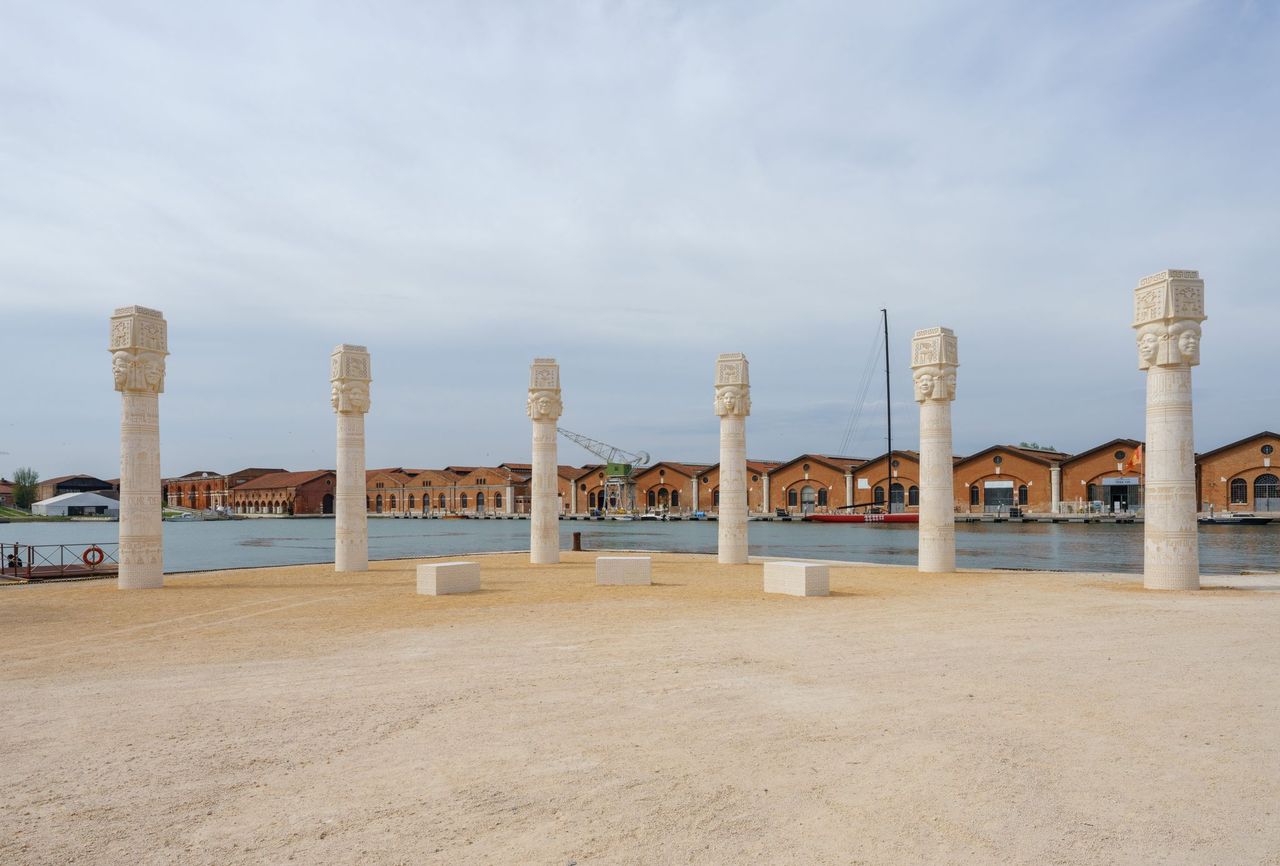
Installation view of Lauren Halsey: keepers of the krown, Biennale Arte (Arsenale), Venice, 2024. Courtesy of the artist, David Kordansky Gallery and Gagosian. Photo: Andrea Avezzù.
Too much creative freedom? Saying that about Halsey’s art is like saying that about Clinton’s funk or Armstrong’s jazz; dreams of creative freedom are mirrors for dreams of socio-political freedom. Halsey’s art and her funk inspirations are rooted in the lived social reality of their communities. On the keepers of the krown columns in Venice (2024), carved Ancient Egyptian religious iconography—the ankh, symbolizing life; the djed, symbolizing stability—borders graffiti-like engravings: “REPARATIONS NOW!;” “PRIDE IN OUR NEIGHBOURHOOD;” “STILL HERE”. Halsey transfers South L.A.’s bold, multi-colored signage and graffiti—foregrounded in an early commercial show (David Kordansky Gallery, 2020)—into gypsum, the same material used millennia ago for Egyptian pyramids and ordinary American houses today.29Graffiti, associated with vandalism and criminality more often than art, typically documents protest and identity within deprived communities. For some, it’s street art on the front lines of gentrification—and its first victim. Halsey situates graffiti not only in “respectable” art world contexts, but regal epigraphic contexts. This is the real power of Halsey’s “remixing” to expand both artistic and social freedoms: it becomes impossible to define borders between illegal and legitimate, passing and permanent. Graffiti becomes sacred, gentrification becomes sacrilege.
But if it’s not redeeming to see funk principles (dis)organizing Halsey’s installations, at least see their wildness as a frenzy to preserve. Halsey’s collect-and-protect world-building joins several 21st-century artists employing documentary archival processes.30Issam Kourbaj’s archival art, for example, often aimed to preserve the identity of his home country, Syria, through civil war.31Like Kourbaj, Halsey sometimes wants ongoing installations that “accumulate archival materials over the course of the exhibition.”32Halsey’s archive protects South Central’s identity from the cultural erasure that accompanies gentrification—but archiving is too impersonal a word for Halsey’s art, too at odds with her funk infrastructure. Funk, for Clinton, “is social”: “You seen these people, they could maneuver through the ghetto and […] don’t get in no trouble […] get a good vibe with everybody. Then you got the funk.”33By embracing contrasts within her community, Halsey’s installations let this social quality blossom. It’s art that echoes what Guy Brett wrote of Divisor (1968) by Lygia Pape, another artist of large-scale installations: it “does not obliterate the individual in the collective.”34Instead, Halsey’s art upscales Clinton’s aspirations—personal safety, optimism, freedom of movement—to the community level: the freedom to decide your neighborhood’s fate.
Prototyping: Art World Robin Hood
Halsey’s art isn’t just about the community of South Central—it’s also by them. This collective composition has more funk inspiration: Halsey notes that at one point the P-Funk collective had 83 band members contributing to the overall funk.35Halsey made her first major public piece, the 2016 float, with the help of her whole block; for the 2018 MOCA show, around 20 people worked in her grandma’s backyard.36 The Crenshaw District Hieroglyph Project was crowdfunded via Kickstarter, and the original plan was for the general public to help engrave the blocks.37But how does Halsey avoid exploiting and commodifying her community’s efforts? How does she avoid what’s something like art world para-gentrification (access limited to wealthy, non-local collectors; profits prioritizing global mega-galleries)? In part, the installation format is itself a defense mechanism, making individual ownership difficult. More specifically, Halsey also states that a certain proportion of her work must end up with collectors of color.38But really Halsey avoids commodification because she drives “for us by us” (or “FUBU”) art much further.
In 2020, Halsey founded the Summaeverythang Community Center with funds from her art sales.39Initially envisioned as a community hub for afterschool tutoring and community music production,40during the Covid-19 pandemic Summaeverythang reoriented to serve its community as a food hub.41Today, with the support of Halsey’s fundraising, the non-profit continues working with local farms to give local people access to fresh and healthy produce, aiming to counter the “food desert” crisis that South L.A. faces.42Summaeverythang is currently undergoing an expansion to create space for the initial afterschool educational vision in 2028,43with long-term plans to lead community-land-trust projects.44Fundamentally, Halsey doesn’t avoid commodification: she embraces art world capital via conscious commodification and a Robin Hood-like approach, taking money from willing art world buyers and giving back to her community. Halsey reverses the familiar, Renaissance-type art world patron-client dynamic: now the artist directly sponsors the city’s glorification. Other artists have involved their communities and charities before,45but most link art and community primarily via funding support—few make their community so intrinsic to the creative process, artistic content and financial rewards.
What’s more, Halsey’s art aspires to return to South L.A. “Prototype” appears in a number of Halsey’s titles, including Prototype Column for Tha Shaw (RIP The Honorable Ermias Nipsey Hussle Asghedom) I & II (Frieze New York, 2019) and the eastside of south central los angeles hieroglyph prototype architecture (I) at the Met. Obviously cross-project artistic testing occurs: take the growing grandiosity of cave-like spaces from MOCA, through Too Blessed 2 be Stressed! (Fondation Louis Vuitton, 2021), to emajendat. But Halsey’s prototyping isn’t primarily for the next artwork, it’s for the following evolution: the exhibition afterlife. emajendat, for example, was prototyping a “funk garden” that Halsey plans to “one day present at home.”46Recently, Halsey has been working on sister dreamer,47a temporary, Egypt-inspired outdoor sculpture park in South Central scheduled for 2026-27, with a program of community activities by Summaeverythang.48Ultimately, Halsey creates prototypes for future “permanently sited” structures in South Central.49Who else could view the Venice Biennale as a mere practice run?
At first it seemed frustrating that the same art world contexts which incubate Halsey’s monumental spaces also ultimately hamstring them: their size, their ability to stabilize a vision of community, has an underlying fragility when you know they’ll be disassembled and shipped off; and their art world bubble means they’re not truly public. But Halsey’s desire to push her works beyond the art world is the bravery to let them prove themselves in more contested public spaces. This is art coming to terms with the art world’s limitations on its power, art becoming aware that depicting Black figures might give the illusion of progress, of safety, of equality, without really working towards it. Kara Walker, revealing the research behind her reworked Confederate sculpture, Unmanned Drone (2025), displays some of her notes in the ongoing L.A. exhibition MONUMENTS.50They include a question: “Who heals a wound that continually opens itself?” Halsey’s relentless prototyping allows for adaptation to that continual opening, and so enables healing. Because success, for Halsey, is art with an expiry date—artworks aspiring to move beyond art institutions to become functional civic work. And there’s joy in art where we’re just happy we’re part of the dress rehearsal.
Angelenos Abroad: South Central on Tour
But how does South Central hyperlocalism fare when Halsey travels abroad? How useful are dress rehearsals outside the US, when visitors are unfamiliar with South Central? It’s certainly marketing, part of the non-profit’s fundraising process, but not just through sheer global exposure to cash and eyeballs: international locations amplify Halsey’s concerns for South Central. Halsey’s columns in the Venice Arsenale—shipyards and armories that built and armed the fleet of Venice’s vast maritime empire for centuries—plugged into global conversations about decolonizing monuments. In a Biennale themed “Foreigners Everywhere,” in a country whose piazzas have housed plenty of looted African obelisks, Halsey’s Angeleno-Egyptian fusion inhabited an intensely colonial space. Far from being enslaved, these African-American faces are shaped in the mould of conquerors—but they’re the benevolently smiling, sometimes bespectacled, faces of contemporary people, weaponless and fleetless. South Central’s appearance abroad challenges Angeleno—and wider US—isolationism; though hyperlocalized to South Central, via intentional international contexts, Halsey’s works are far from parochial. Halsey’s community care travels well because the works are so South Central-focused, not despite it: global and local cares aren’t seen as mutually detrimental.
Similarly, emajendat at Serpentine South intersected with both national and international contexts. Portraits of Black figures were painted on the exteriors of the caves and nearby boulders. My mind, like a clichéd tourist in the US, went first to Mount Rushmore—a full-color South Central version. But if you’re familiar with the ongoing US debate about Stone Mountain in Georgia, there might be a more jarring resonance with that monumental relief sculpture, depicting three Confederate leaders. The carving of the Stone Mountain relief, situated at the site of the KKK’s 1915 re-foundation, was restarted in 1963—the same year that Martin Luther King exclaimed “Let freedom ring from Stone Mountain of Georgia!” in his “I Have A Dream” speech.51But Halsey’s rock formations gesture towards a more wholesome landscape reclamation. emajendat’s cream-colored rock faces, glowing with veins of neon pink and green ores, are light and airy, part cloud: the smiling portraits float there like the faces of guardian angels.
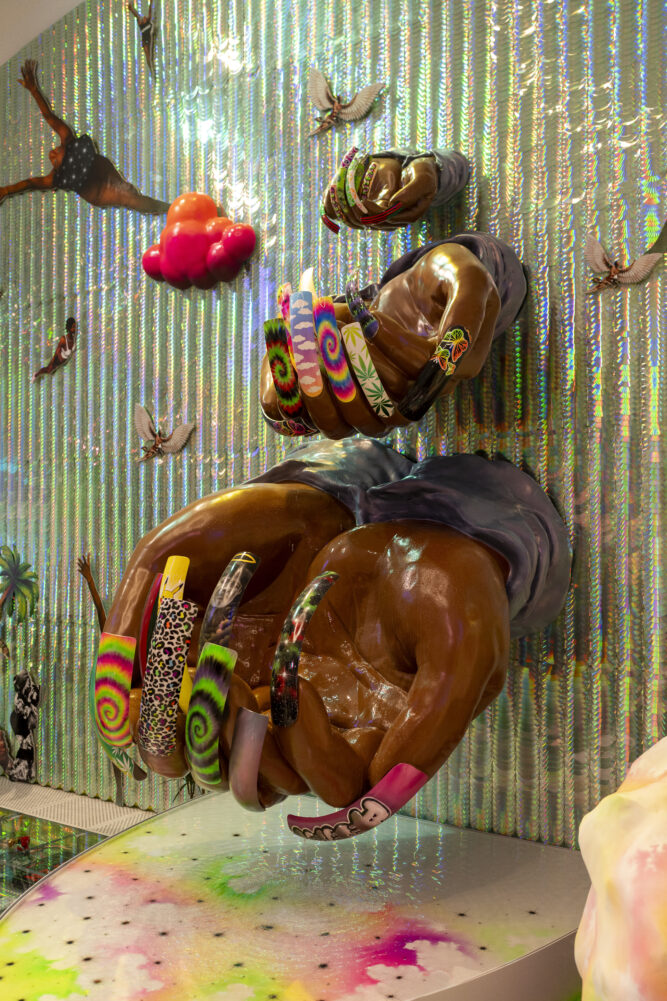
Lauren Halsey, emajendat, 2024. Installation view, Serpentine South. © Lauren Halsey. Photo: © Hugo Glendinning. Courtesy Serpentine.
And, like the Arsenale location in Venice, emajendat’s London location was cleverly contextualizing. In the central room, though glinting CDs covered the floor and walls, the sole sound was a fountain’s calming trickle: water flowed down three large pairs of hands—each larger than the last, each cupped to drink or receive a blessing, each bristling with wildly colorful acrylic fingernails—and into the pool below. This serene fountain was located within Kensington Gardens, a Royal Park in a wealthy part of London. Perhaps Halsey hinted at South Central’s lack of green spaces, beyond those combating homelessness.52More than that, Halsey’s installation becomes a grotto like those of the wealthy (sometimes slave-trading) elite of 17th-19th century Britain—the kind of grotto certainly conceivable in a Royal Park like this. Except here a grotto’s tranquility, mysticism and protection aren’t centred on wealth and seclusion: here’s a delightful sanctuary of inclusion. This is the beauty of Halsey’s archival process: even in places of historical privilege, Halsey enables her community to feel dignity and safety.
There’s reverence across all Halsey’s installations, whether in monuments or the grotto-like tranquility of “funk mound” caves, where figurines often perch in shrine-like alcoves that evoke reliquaries or religious dioramas. It’s an ancient feeling: we become pilgrims and worshippers in numinous spaces. Here Halsey diverges from the Afrofuturism which she’s often said to represent. Certainly, Halsey overlaps somewhat with the music and literature of Afrofuturism as conceived in the ‘90s: her Egyptianizing draws on that same tendency seen in Sun Ra’s early Afrofuturistic film, “Space Is the Place” (1974), for example. But that Afrofuturism is often sci-fi-dominated: Sun Ra’s film involves an African-American mothership settling on a new world in outer space. Afrofuturism can be criticized for forgetting the present; as Harmony Holiday writes, “Afrofuturism offers fully-actualized Blackness in a neverland, somewhere that cannot be named,” and aspires “to worship the ghost of the future.”53Halsey’s work is Afrofutur-ish: she largely avoids sci-fi tendencies. Rather than escaping skywards towards a far off future, Halsey’s future-theorizing is more immediate and grounded. Space is not the place for Halsey: she shapes and protects space in the earthly present.
So, traveling abroad, Halsey’s installations do what Afrofuturist motherships aspired to do all along—propel African-American communities toward new hopes—but they do so in the here and now. And, what’s more, the goal isn’t a distant galaxy: the place these installations are seeking is back where they started in South L.A. There’s no need to desert the city, let alone the planet, to find a more promising future. Halsey’s installations are on a pilgrimage home.